You feel it on the flight in.
Cutting through clouds into sunshine, our Bhutan Airlines Airbus A319 begins its maze-run of mountains into 7,333-foot-high Paro Airport. This approach is a slow-motion video game; a double-black slalom of green terraced hills and bright dzongs (fortress-monasteries) so technical, fewer than 30 pilots are qualified to fly it. Those who do often say a prayer before the approach. This is to honor a nearby hilltop Buddhist monastery, but, you know, still …
Coffee is on my mind. I’ve slept two hours in two days, crossing 11 time zones from New York City to Doha, on to humid Bangkok, then Kolkata, India, before this final 90-minute hop to Bhutan. It’s late-August. My first visit to Bhutan. My seatmate for the last leg is a friendly 30-year-old Bhutanese man. He tells me he moved to Canberra, Australia, 18 months ago to join his sister. This is his first time home since moving. In Bhutan, he was a teacher. In Australia, “I clean houses and drive Uber.” He is visibly excited to be heading home. On the approach, I see the man glued to the right-hand window. His eyes scan the hills. Counting down his return.
“Kindly fasten your seatbelts.”
Our pilot banks us left, toward a rapidly approaching hillside. I notice a traditional Himalayan white khada scarf — given to travelers by loved ones for safe passage — wedged into the top of our economy section divider for good luck. I look back out the window and feel it again: We’re heading somewhere special.
With a thwump, we touch down on Paro Airport’s runway No. 1 of 2 in an endless valley of green. We exit the plane to silence. It’s as if we’ve stepped into a land lost to time. A land in which I have a tee time, tomorrow.

Bhutan is a country of 780,000. It’s slightly larger than the state of Maryland — 1/8 the population — landlocked in the high Himalayas between China and India. It has always done things differently. In the 1970s, by Royal decree, Bhutan adopted a policy ofGross National Happiness. Family, friendship and cultural traditions were emphasized. A “Gross National Happiness Commission” was formed. Students were assigned two minutes of meditation each day. Happiness reminder signs sprouted alongside roads and hill paths.
Today, Bhutan still prioritizes these values, including respect for nature. Sixty percent of Bhutan’s land must remain forested. All mountains, considered sacred, are closed to climbers, giving Bhutan the world’s highest unclimbed peak: 24,835-foot Gangkhar Puensum (take that, Everest). There are no traffic lights. The first Bhutanese TV set didn’t arrive until 1999. And there is golf. Which is why I’m here.
I’d first heard about Bhutan’s golf scene in, of all places, Nepal. It was 2022. I was heading to the world’s highest golf course, Mustang Golf Course, 15,239 feet up in Nepal’s remote Upper Mustang. For two days, 40 Nepali golfers and I had rattled upwards in a mud-caked caravan of twelve 4×4 Mahindra Jeeps, bound for Mustang’s opening tournament, the “Top of the World Golf Classic.” The night before our arrival, in the town of Kagbeni, I overheard several golfers talking about the beauty of Bhutan’s golf courses. Intrigued, I asked my table-mate, a Nepali golf pro named Deepak Magar, if he’d ever played in Bhutan. The older pro smiled back:
“In 1993, I won the Bhutan Open.”
Ever since that evening, I’d been obsessed with visiting Bhutan. A country that prized happiness. A country long hidden from the outside world. A country that, unexpectedly, had golf.
“We’ll head out in a minute.”
Phuntsho “PG” Gyaltshen, 49, the soft-spoken president of the Bhutan Golf Association, leads me to the outdoor patio of Royal Thimphu Golf Club, baking in the afternoon heat. The terrace overlooks the par-3 1st hole, with soaring hills beyond. We’re in Bhutan’s capital of Thimphu. Phuntsho wears a fancy maroon robe called a gho, standard men’s attire in Bhutan (women wear similar robes called kiras). My host motions to a table of golfers drinking butter tea — a Bhutanese staple involving tea, yak butter and salt.
“I want to introduce you to some people.”
Bhutan has only about 300 golfers, including those in the armed forces. Not exactly Scotland numbers. Yet those who play are as obsessed as St. Andreans. Around 20 Bhutanese golfers are below a 5 handicap, with five holding plus-handicaps, and Bhutan’s best golfer, Tshendra Dorji, a +5. (Fittingly, he is the national coach.)

Golf came to Bhutan in the 1960s. An Indian Army officer, with the blessing of Bhutan’s Royal family, built several holes in Thimphu. Today, Bhutan’s golf community plies its slices over the country’s four courses — Drakpoi Golf Club (owned by the Royal Bhutan Army), India House Eco Park (on the grounds of the Indian Embassy in Thimphu), Haa Nature Park (two hours from Thimphu) and Royal Thimphu Golf Club (Bhutan’s oldest course, formally established in 1972). All are nine-holers, with separate front and back-nine tees. All are above 7,500 feet in elevation. I’ll be playing each course on this trip. And mustering the courage to try ema datse (chilies in cheese sauce, Bhutan’s national dish, said to be some of the hottest food in Asia).
“Please sit with us,” says a cool-looking member named Dru, whose gho and sunglasses give him an actorly look, like Adrian Brody’s character in Succession. Dru makes space for me beside him. “We’ll order some butter tea for you.”
Royal Thimphu, I’m quickly learning, has a lively social scene. Within the club’s membership are other smaller social clubs — each with monthly medals, complicated handicapping systems and memorable names.
“The largest two clubs at RTGC are Weekend Golfers Association and Frenemies,” Phuntsho explains, as I’m served a steaming cup of butter tea. “Frenemies has, like, 100 golfers in it. We’ve also got subgroups within Frenemies.”
“Do those have names too?” I ask. There are nods, then a volley of examples.
“Dragon Boys.”
“Bogie Boys.”
“Chocolate.”
“Any others?” I ask, prompting one more (my favorite): “Stylish.”
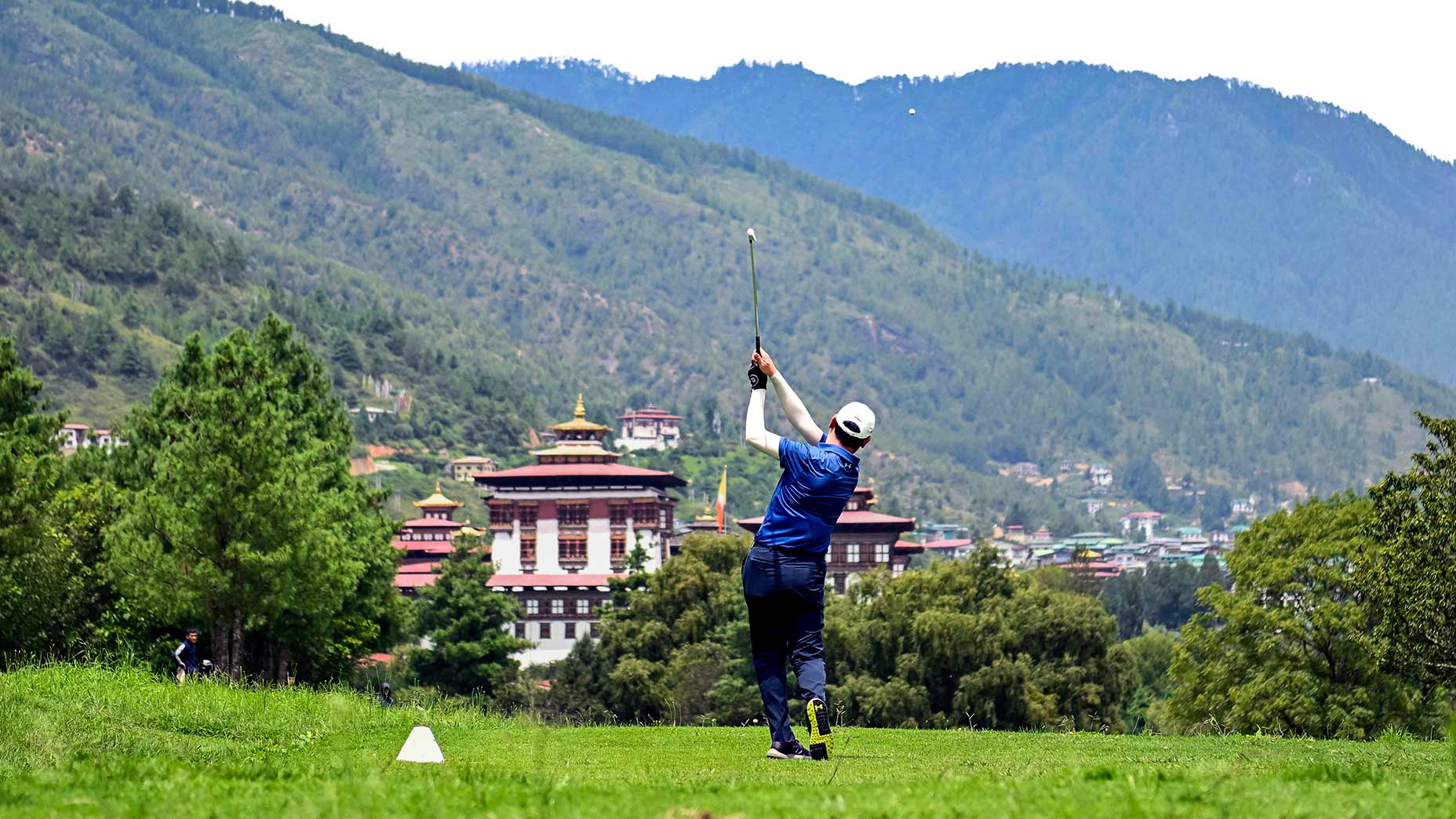
Fifteen minutes later, we head onto Royal Thimphu. Peach and pine trees line fairways. Woodpeckers dart between them. From the 5th tee, golfers casually aim at the maroon and white towers of Tashichho Dzong, the capital’s government building — the equivalent of American golfers carving fades off the White House. (PSA: On the 4th hole, shouting FORE! is banned, due to the hole’s proximity to the King’s private office). Spirituality is everywhere. On the 2nd hole, the ideal line from the tee is on an ancient hilltop monastery. On the 7th tee, a 17th century stone stupa (a religious monument) stands 50 yards past the tee, on the course, with white prayer flags surrounding it. I recognize these white flags from my drive into Thimphu. The same flags cover Bhutan’s hills — memorials placed by families for departed loved ones.
“Hey, Phuntsho,” I call out.
Phuntsho walks back over to me. “Yes?”
I point to the white flags in front of the stupa, eager to impress my host. “Are those flags in memory of club members who have passed?”
Phuntsho seems puzzled.
“No, they’re to stop balls hitting the stupa.”
Yet the most unique sight at Royal Thimphu comes on the 9th tee. The aiming point for tee shots? A 167-foot-tall gold Buddha atop a distant hill. (For those seeking inner peace for golf games, this is the right tee box.) As I stare, a member lining up his drive turns back to me, makes a pre-shot confession: “We all start on the Buddha … but we don’t all finish on the Buddha.”
By the way, if you hit the solar panels, you need to pay 40,000 ngultrum.
The next day, I drive to Drakpoi Golf Club on the northern edge of Thimphu, passing smiling schoolkids in ghos and kiras walking to class. DGC is owned by the Royal Bhutan Army. It’s played mostly by generals and soldiers, although civilian Royal Thimphu members will flock here for practice rounds before DGC’s “Royal Wedding Tournament” each October.
I’m glad I flocked too. DGC’s 1st tee opens onto a valley of technicolor-green. Fir trees hug fairways, stretching into breathtaking hills of the Kabisa Valley. I feel as if I’m in Montana or Colorado or Switzerland.
“Kuzuzangpo la!” [Hello!] I hear from behind me. The others have arrived.
My playing partners for this round are Mila Palden Penjore, a cool 24-year-old Bhutan Airways pilot who attended flight school in Florida, Dechen Lhendup, 24, who played in the Bangladesh and Nepal Amateur Opens this year, and Tshendra Dorji, 32, intensely humble, yet the best golfer in Bhutan, with the course record at Royal Thimphu: an 11-under 59. Tshendra coaches Mila and Dechen, as well as practically every other golfer in Bhutan.
“You can go first,” I tell Mila. The pilot, a 4 handicap, jet-stream-launches his opening drive 290 yards down the middle. The others match him. I’m playing with three of the longest hitters in Bhutan, who in this 8,200-foot altitude, have tee-shot trajectories evoking PGA pros. Nervously, I bunt a 3-hybrid down the left side, evoking nobody. I need lessons from Tshendra.
DGC has its own spirituality. On the 3rd tee, our target is another centuries-old stupa, this one in the middle of the fairway. “Just aim on the stupa and you’ll be good,” Mila says, drilling his drive over it. Dechen does the same.
“Where else are you playing in Bhutan?” Tshendra asks me.
“Oh, all the courses. Even the one in Haa,” I say.
“Great. You’ll love that one,” Mila replies. “On the drive to Haa, you go over the Chele La Pass — highest driving road in Bhutan, 13,083 feet. Some golfers even stop and a hit a golf ball from there.” The others smile. I think about what golf means here. How, in a nation prioritizing happiness, golf is my playing partners’ source of joy. I think of the hundreds of rounds I played with my dad in his life (he passed in 2020); bump-and-running from Van Corlandt in the Bronx to the Old Course in St. Andrews. I think about how much happiness the game brought him; how many giggles we shared like Bhutanese schoolkids. America and Bhutan may be deeply different, but when it comes to what golf gives us, we’re cut from the same Gore-Tex.
My group reaches the 4th hole. And another unlikely course feature. An array of solar panels along the left side of the fairway. “It’s called the ‘DSP-Solar Initiative,’” Tshendra explains. “There are over 3,000 panels.” “Oh, wow,” I reply, impressed, and tee up my ball. As I’m over my drive, Mila casually makes another announcement.
“By the way, if you hit the solar panels, you need to pay 40,000 ngultrum.”
I back away. “Wait, what?”
“Yeah. Well actually, it depends on which type of panel you hit. It’s 29,000 for the small panels, 40,000 for the large panels.” Tshendra points to a sign confirming this. There’s an uncomfortable pause.
“How much is 40,000 ngultrum?”
“About 500 dollars.”
There have been moments of greater Zen in my life.
I re-address my ball, now consumed by the solar minefield to my left. I’m so sure of a coming pull-hook, Bob Rotella would be ashamed. I swing, then open my eyes. Miraculously, I’ve seared a slice into the other fairway.
“Next time, tell me about the panels after my shot,” I mutter. I don’t ask what happens to the fine for a ricochet between multiple solar panels, in case we’re playing the back nine.
Gross National Happiness is only one part of Bhutan’s focus. A largely Buddhist nation, Bhutan bans the killing of any animal. All meat is imported from other countries. So many protected wild animals roam Bhutan, the country has been called a “Noah’s Ark,” with Bengal tigers, Indian rhinos, snow leopards, red panda, black-necked cranes, plus Bhutan’s national animal, the moose-like takin.
There are other initiatives, too. Bhutan is net carbon negative. Bhutan has a nationwide ban on plastic bags. Bhutan is planning, near its southern border in Gelephu, a 1,000-square-kilometer “Mindfulness City,” to be built around a series of habitable bridges, prioritizing well-being for residents.
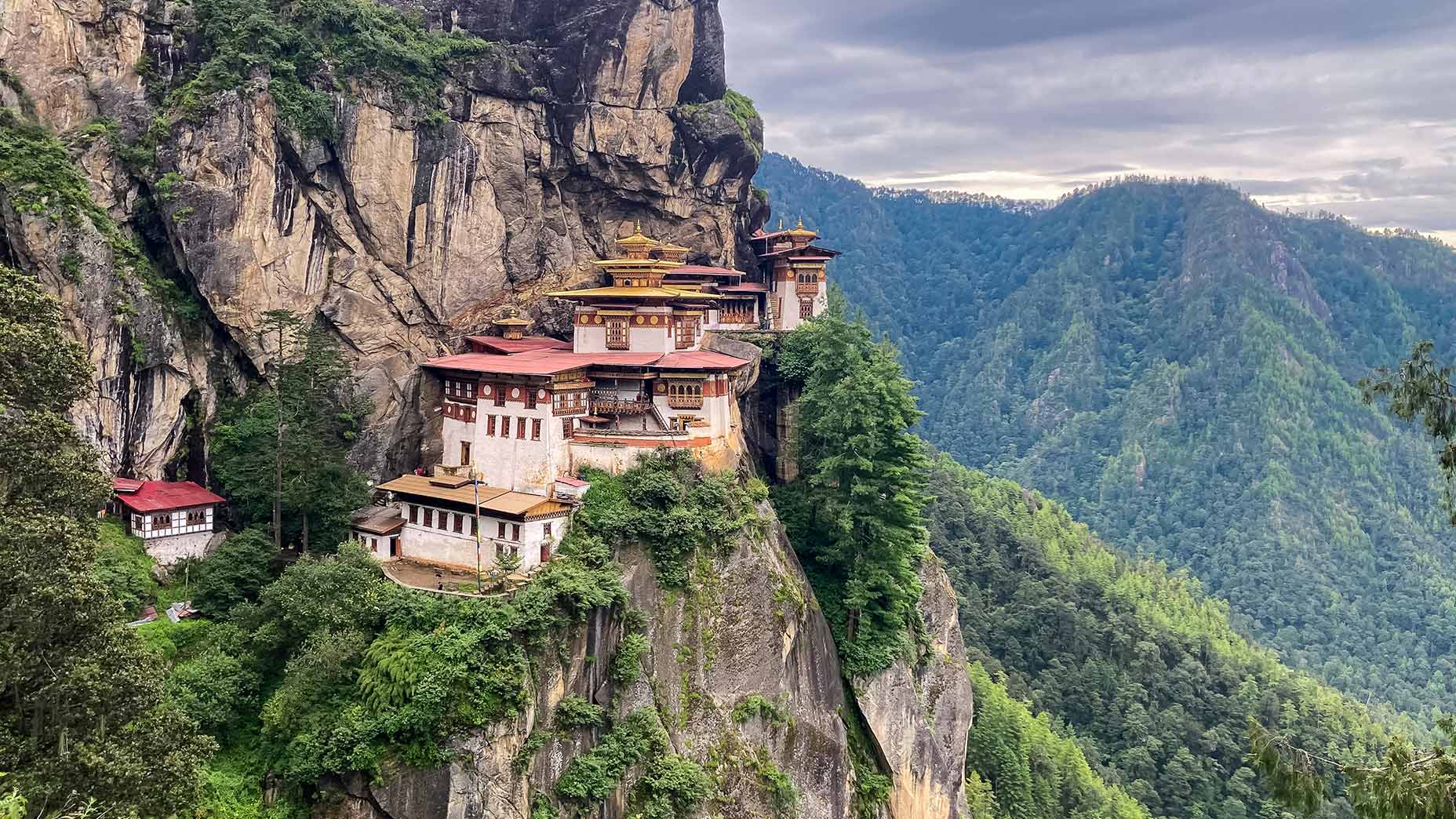
A constant in Bhutanese life is a connection to nature. It’s one of the best reasons to visit. Everywhere you turn, there are adventures to be had. The country’s jewel, the iconic Tiger’s Nest monastery near Paro, is perched on an airy cliffside, reached by a memorable hike. The famed Snowman Trek, a 25-day expedition through Bhutan’s wilderness, is considered one of the toughest treks in the world. Even from a car, the landscapes are breathtaking. On drives linking Thimphu and Punakha, Haa and Gangtey, prayer wheels sit beside roads. Trees cling to slopes so steep, it doesn’t seem possible they could hold on. Monasteries dot distant ridges. Prayer flags hang from hills.
Golf fits Bhutan more than meets the eye. There is a long tradition of outdoor sports. Archery and khuru (outdoor darts) are popular. So is a rock game called digor. Recently, mountain biking has exploded in Bhutan. And in 2024, to the nation’s pride, two Bhutanese athletes competed in the Paris Olympics, while Jigme Pelden Dorji, a lieutenant in the Royal Bhutan Army, became the first Bhutanese climber to summit Mt. Everest.
When you look at Bhutan on the international golf stage, you don’t yet see a lot of wins. But Bhutan is trying. The loftiest goal for the Bhutan Golf Federation is to have a winner of the Asia-Pacific Amateur (which provides entry into the Masters). Mila Palden Penjore has played in five Asia-Pacific Amateurs, plus the Singapore Amateur Championship. Bhutan also sends competitors to the South Asian Games, the Asian Games and the All-India Championship, as well as to the Nepal and Bangladesh Amateurs.
“We do get other invites,” Phuntsho says, as we sit on the patio at Royal Thimphu having lunch. “Hopefully we can start sending our players elsewhere. But our next goal is to win anything outside Bhutan.”
The kids are grinding. Each July and December during school holidays, Bhutan holds month-long junior coaching camps at Royal Thimphu. Around 200 children join, some as young as 6-years-old, many from remote areas of the countryside. The camps meet five days a week (snacks and school stationary provided), all coached by Tshendra.
“We’re trying to get Tshendra extra coaching certifications too,” Phuntsho says, as another cup of butter tea is set down for me.
Talk turns to what everyone loves about golf.
“I mean, we get to hang out; that’s the most fun,” says Mila. “You chat about stupid things with your friends. It’s like a break from everything else — it’s so nice.” Phuntsho nods.
“If I’m in Thimphu and I’m not playing golf, I feel off,” he says.
It’s one of my last days in Bhutan. I’m at India House Eco Park Golf Course, on the grounds of the Indian Embassy, trying to dodge a lightning storm.
“We should hurry.”
Phuntsho is with me. So are thunder clouds, rumbling closer with every pitch shot. I remember that I did get blessed by a monk this morning (my hotel’s “in-house monk”), although I’m not sure how deeply I want to test that protection.
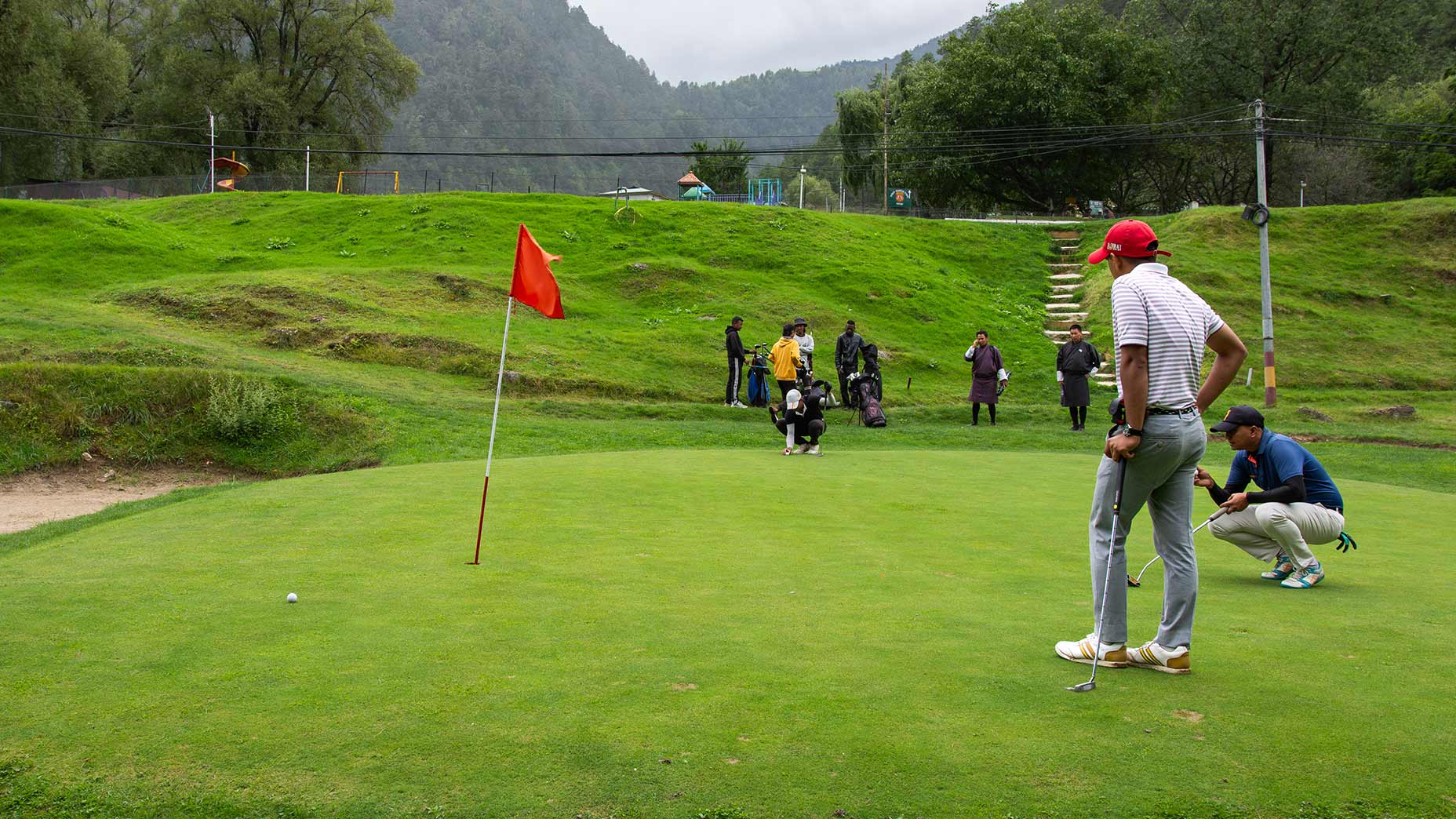
The sights are worth the storm. India House Eco Park is unlike any other course I’ve played. With limited land (this is, after all, Embassy-first, agronomy-second), India House’s designer had to get creative. Very creative. Like, think a “Wild Man Open” with tees and greens scrambled. Here at Eco Park, there are holes over trees without obvious lines, holes to tiny shared greens, holes with approach shots over other greens. It is wild. And wildly fun.
“Uh, where do we hit now?” I ask Phuntsho, as we stand on the 3rd tee. We’ve just finished a short, demonic par-3 to a steeply-uphill green, approach blocked almost entirely by fir trees. Our reward is this blind tee shot toward a wooded wilderness.
“On that tree,” Phuntsho says, unfazed by a symphonic thunder-clap. “Par-5.”
Maybe it’s the compact layout, or the seclusion, but this course feels like someone’s secret garden. A garden in which everyone playing is connected to the Indian Embassy. India House does occasionally open to the public. Each November, when fairways turn firm and butter-yellow, India House Eco Park hosts the “India House Open,” played since 1995 with roughly 200 competitors each year.

One hole scares them all. India House Eco Park’s claim to fame is having Bhutan’s hardest hole, by far. The 8th, a short par-4 with a raised greenkeeper’s revenge-style green (cut fiery-fast for the tournament), water hazards sandwiching the putting surface, and a forced drop zone in front. It is a card-wrecking nightmare. Which nobody knows better than Bhutan’s best golfer, Tshendra Dorji. In 2015, Tshendra was leading the India House Open, until the 17th hole, the back-nine 8th, where he made a 44. (A lot of water, a lot of drop zones). Tshendra received a consolation medal at the award ceremony. To this day, the Bhutanese van-de-Velde-ian moment lives on.
“Yes, that should be good,” Phuntsho calls out, as my drive fades into the unknown.
“Thanks, Phuntsho.”
I pick up my tee and get moving. As I walk, I catch myself scanning the hills, like my seatmate on the flight in. Maybe it’s the setting. Or the kindness of my golfing hosts. Or all the butter tea. But I feel it again. I’m somewhere special.
What can we learn from Bhutan? The country’s happiness initiatives aren’t a magical antidote to suffering. Lives here can still be difficult. But it’s moving to see a government grapple with the big questions: What gives life meaning? What is helpful for a happy life? For Phuntsho and Mila and Tshendra, golf is part of the answer. For me too.
Another rumble. Phuntsho looks back. “Want to play a few more holes?”
Absolutely.
YOUR TURN: Here’s how to play in Bhutan
When: April-June and September-October are the prime golf months.
Where: Thimphu, Bhutan (plus extra sightseeing in Paro)
How to get there: The cheapest routing is generally via Kathmandu, Nepal. Cathay Pacific flies there from multiple U.S. cities, with round-trip fares starting at $730. From Kathmandu, Bhutan Airlines — the only carrier besides Drukair to fly into Bhutan — flies to Paro, Bhutan, with round-trip fares starting at $440. Flights into Bhutan are also possible via cities like Delhi, Dubai, Bangkok, Singapore, Kuala Lumpur and Hong Kong, although these are more expensive.
How to get in touch: Contact the Bhutan Golf Federation for more information, email here. You can also simply show up at Royal Thimphu Golf Club to play as a walk-on (club rental available). Green fees at Royal Thimphu: a very reasonable $60.
Where to stay in Bhutan:
In Thimphu:
Budget Option: Zhiwaling Ascent Thimphu. From about $205/night. Located in a peaceful, wooded area just above the city, with a magnificent rooftop yoga studio and sauna.
Mid-range Option: Pemako Thimphu. From about $545/night. In Thimphu-proper, with seriously stylish rooms, four restaurants and architecture modeled on Thimphu’s dzong.
Lux Option: Six Senses Thimphu. From about $1,450/night. Stunningly-situated above the Thimphu Valley, with integrated wellness programs, organic ingredients picked from the property’s garden, plus a gorgeous pool. A tremendous place to unplug.
In Paro:
Paro Zhiwaling Heritage. From about $650/night. Bhutanese-owned and exquisitely decorated. Set on 12 acres with archery fields, a fantastic fitness cetner, a greenhouse open to guests, and a Royal Raven Suite with private in-room shrine.
Visa logistics: U.S. citizens must obtain a visa in advance ($40 per person). You’ll need to also show proof of travel insurance as part of the application.
Other logistics: Bhutan does their tourism differently than you’re likely used to in other countries. There is a $100/day Sustainable Development Fee (the ‘SDF,’ which goes towards supporting education in Bhutan). If traveling outside the capital Thimphu, you’ll need a guide and driver. This means that the best way to visit Bhutan — by far — is through a tour company. They will arrange all logistics for you, including a guide, driver, hotels, food. Booking the trip independently doesn’t really make sense yet for Bhutan.

What else to do while in Bhutan:
In Paro, hike to the famed Tiger’s Nest Monastery (around two hours up), where you’ll marvel at one of the most extraordinary sights in the Himalayas. When you’re back in Paro, visit the stunning Paro dzong, then relax in a traditional Bhutanese Hot Stone Bath overlooking tranquil rice paddies (many Hot Stone Baths are available at farmhouses around Paro; your tour company can easily book one for you).
In Thimphu, visit Thimphu’s dzong, as well as the gigantic gold Buddha Dordenma (on which you aimed at RTGC’s 9th tee). Also visit the cool multi-use ChoeGo Center, run by the De-suung (Bhutan’s version of the Red Cross), where you can eat, rent bikes and even get a great haircut. Also check out the National Textile Museum and the Royal Takin Preserve (where you can see Bhutan’s national animal). At night, cheer on Thimphu’s soccer team, Thimphu City FC, at Changlimithang Stadium. And rent a gho or kira for the day or evening, which will delight locals. Finally, try ema datse (chilies in cheese sauce). But be warned: it’s hot.
Oliver Horovitz is a New York City-based golf writer and the author of “An American Caddie in St. Andrews.” A former 11-year caddie on the Old Course in St. Andrews, Scotland, he has competed in the Mongolian National Open, the All-Japan Park Golf Championship, Iceland’s midnight golf “Arctic Open,” and on the world’s highest golf course: Nepal’s Mustang Golf Course at 15,239 feet.