It’s a fact that on the PGA Tour the best iron players don’t just rely on soft feel or responsiveness. It’s the marriage of sole and turf that separates “pure” from “pretty good.” When you watch the way ball-striking purists operate, there is a distinct, rhythmic conversation happening between the sole of the club and the turf beneath it. It’s an intimate relationship, a marriage of physics and feel that either unlocks a player’s ultimate potential or leaves them fighting their own hands.
For 2025 U.S. Open Champion J.J. Spaun, that marriage isn’t just a technical preference. It’s the absolute bedrock of his success on the golf course.
We spent some time with Spaun on the Srixon tour truck and asked him to dissect the architecture of his bag. You won’t hear him chase the modern siren song of raw, unadulterated distance. He isn’t chasing 185 mph ball speeds. He’s tried speed training — tampering with tools like the Stack System — and while the launch monitor flashed bigger numbers, the grid grew wider. The control deteriorated. For a guy who relies on picking targets and bleeding the ball into tight pins, sacrificing control for a few extra yards is a bad business decision. Instead, Spaun settled comfortably into his sweet spot in the mid-170s with the driver. That is his DNA.
But where the magic truly happens, and where his U.S. Open triumph was engineered, is from the 4-iron down to the pitching wedge.
The Core Link: Finding the spin window
Before you can even look at iron shapes or sole grinds, everything has to start with the golf ball. It is the only piece of equipment used on every single shot, and for an efficiency specialist like Spaun, it represents the baseline of his entire technical ecosystem. If the ball isn’t reacting correctly, the best iron setup in the world becomes completely useless.
For years, Spaun bounced between models looking for the right fit. He initially played the standard Srixon Z-STAR, but felt there was room for improvement. When he experimented with the firmer Z-STAR XV, the spin numbers dropped too low, robbing him of the holding power he needs on difficult tournament tracks.

Srixon Z-STAR DIAMOND Golf Balls
View Product
The breakthrough came when Srixon developed the Z-STAR Diamond. For Spaun, it was a Goldilocks scenario. Sitting right between the other models in terms of compression, it immediately delivered the exact spin profile he wanted through the bag.
When testing a new ball, Spaun doesn’t start on the launch monitor with a driver. He starts with the shortest shots in the game — chipping and putting — to evaluate the acoustics and tactile feel. If a ball sounds too hard or feels clicky off the face, it gets crossed off the list immediately. Once the short-game feel is validated, he moves up to his iron play. While a driver can always be adjusted via different heads, sleeves and shafts to manipulate launch conditions, the irons are fixed. Spaun needs to see his standard numbers — right around 6,800 to 7,000 RPM with a 7-iron — to trust the ball. The Z-STAR Diamond hit that window perfectly, acting as the critical link between his swing and his iron performance.
Perfecting turf interaction
Iron play is Spaun’s undisputed strong suit. It’s the part of the game where his numbers have remained practically identical since his college days — featuring a precise 11-to-13-yard gap between every single club. That predictability breeds the kind of elite distance control required to survive U.S. Open setups. However, maintaining that level of consistency requires an iron setup that acts as a natural extension of his delivery.

Srixon ZXi7 Custom Irons
View Product
Spaun is what tour fitters call a “trap fader.” He shifts aggressively into the ball, delivering the club with a steeper angle of attack, compressing the golf ball, producing a tight, predictable fade. When a player strikes the ball with that specific downward force, the interaction between the metal and the earth becomes volatile. If the sole design is wrong, the club digs, the face rotates and the launch dynamics vanish.
This is exactly why Spaun’s reliance on Srixon’s V-Shaped Sole design is less of a spec choice and more of a technical savior. The V-Sole is engineered with a higher bounce on the leading edge and a lower bounce on the trailing edge. For a heavy compressor like Spaun, this shape prevents the club from getting stuck in the ground. In simple terms, the club gets in and out really quick.
As Spaun recalls, he once picked up an old Nike Vapor iron from a decade ago just to check his old grip habits. The moment he swung it on soft turf, the club dug like a shovel. Without that specialized V-Sole geometry, his natural delivery style was penalized by the ground. The Srixon sole, by contrast, gets in and out of the turf instantly. It doesn’t bounce off the ground aggressively, nor does it dig and alter the face angle or loft at impact. It simply glides, preserving his natural launch conditions and spin rates.
To optimize this turf marriage across the set, Spaun utilizes a blended combo flow that has become a staple among Srixon staffers. He runs the more forgiving, hollow-bodied ZXi5 heads in his 4- and 5-irons. These clubs provide the elevated launch angle, higher peak height and necessary spin to keep long iron approaches holding firm greens. From the 6-iron down through the pitching wedge, he transitions into the traditional, precise cavity-back profile of the ZXi7, mated to True Temper Dynamic Gold X100 shafts. It’s a setup optimized for ball speed, peak height and that tight spin profile provided by the Diamond ball.
The all-terrain wedge setup
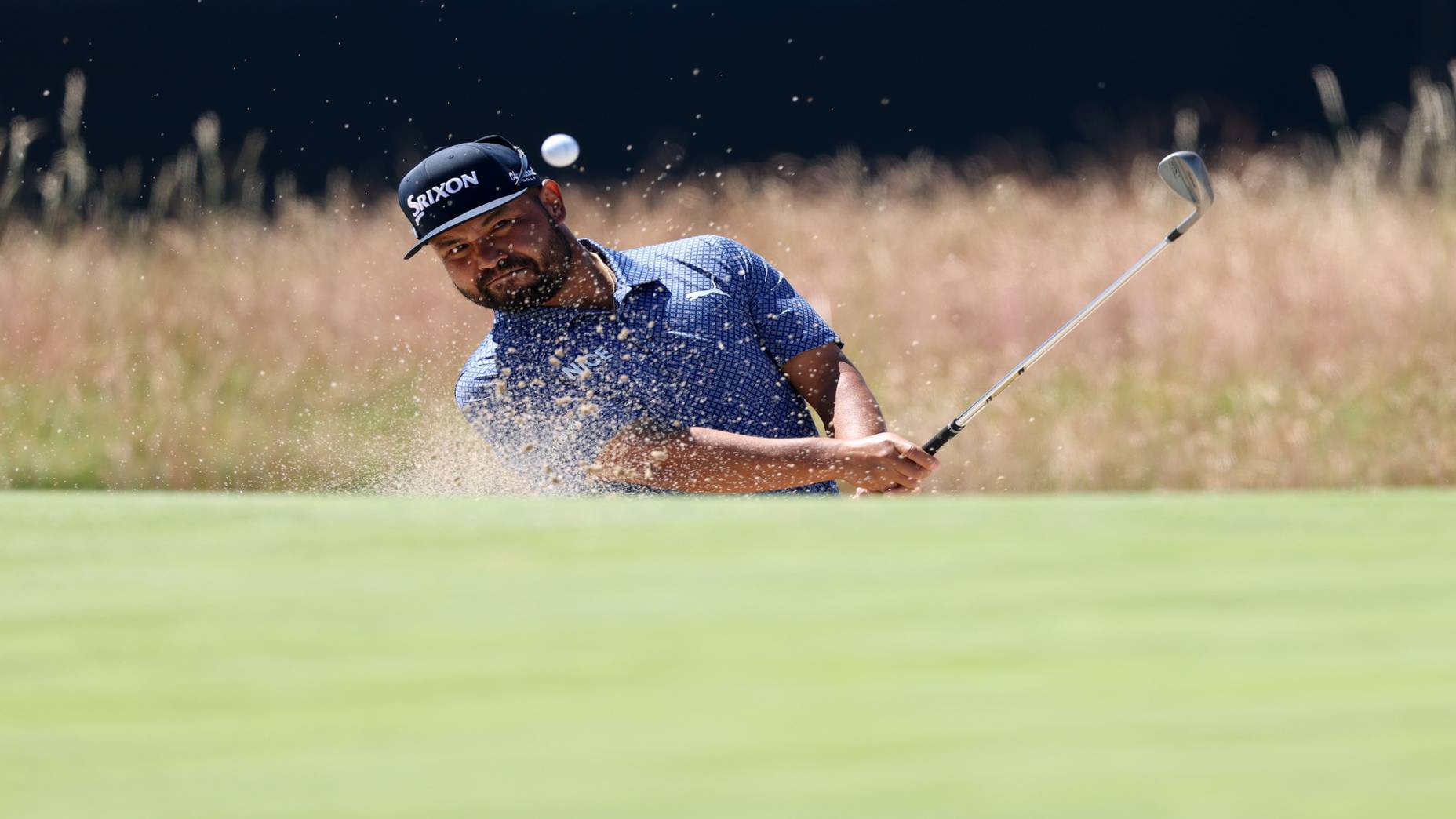
That meticulous obsession with ground interaction naturally bleeds right into his scoring wedges. Spaun works heavily with the tour team to dial in his Cleveland RTX ZipCore wedges. While his 50-degree gap wedge stays fairly standard, and his 54-degree carries plenty of bounce to handle standard rough and fairway shots, his 60-degree lob wedge is a pure piece of mechanical art.
Rather than traveling with multiple lob wedges of varying bounces to match changing weekly course conditions — a common practice for players like Xander Schauffele — Spaun prefers a singular, “all-terrain” weapon. He and the Srixon builders designed a custom, one-off wide sole configuration with heavy heel and toe relief. The wide sole ensures that if he encounters wet, soft conditions, the wedge has enough surface area to resist digging. Conversely, if the turf turns firm and tight, the heavy heel and toe relief allows him to open the face completely, lowering the leading edge to slide directly under the ball without the bounce kicking the club into the equator.

Cleveland RTZ Custom Wedge
View Product
At the absolute highest level of professional golf, equipment is rarely about finding more distance or forcing a player into a radical swing change. It is about creating a symbiotic relationship between a player’s natural movement and the physics of the golf club.
J.J. Spaun doesn’t fight his swing tendencies, and he doesn’t fight the turf. By marrying his trap-fade delivery to an iron, wedge and ball combination built explicitly to master the ground, he turned a repeatable, reliable action into a U.S. Open-winning machine. He’s without a doubt one of the most efficient players you will find on Tour.