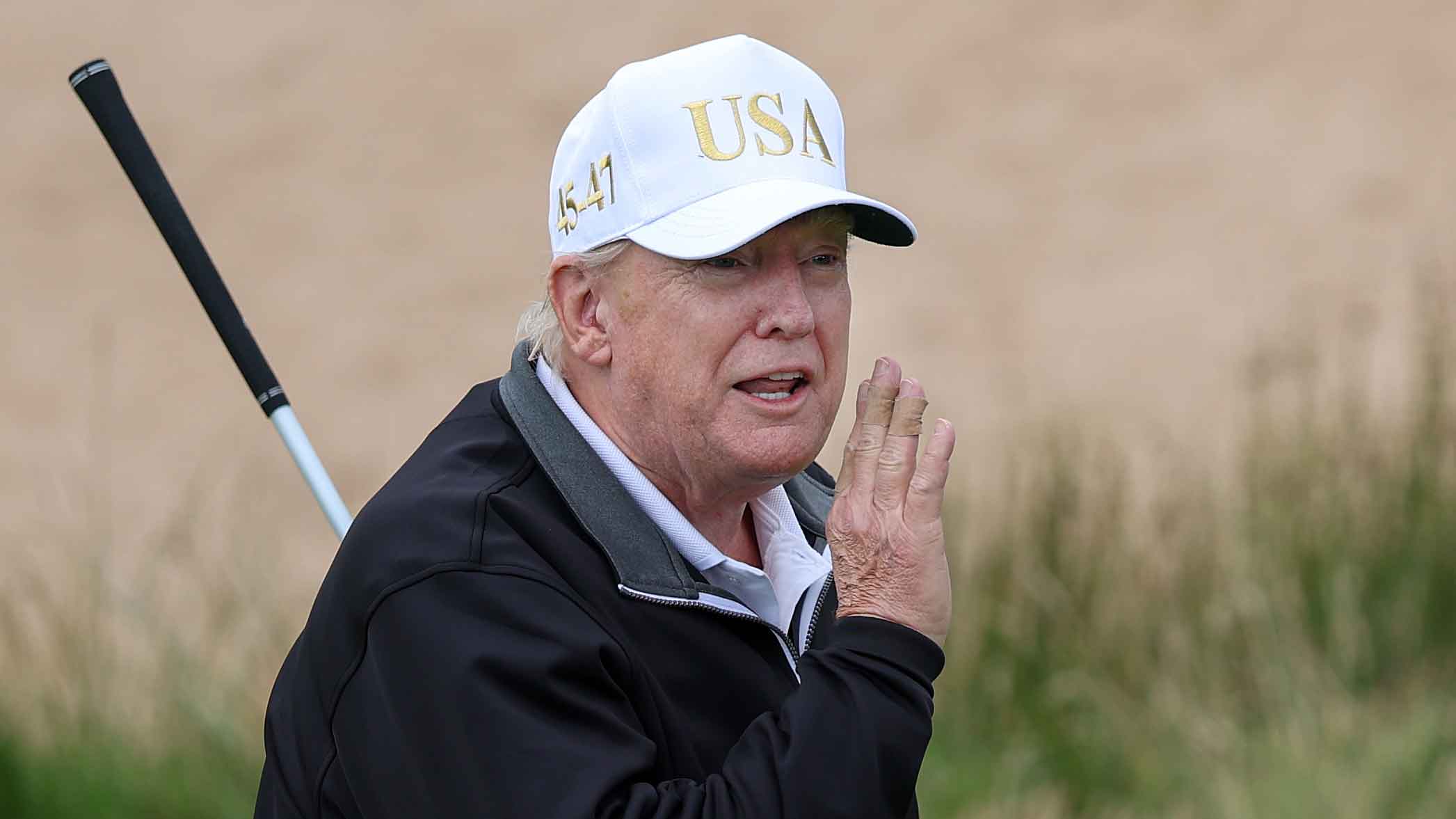
The most significant chapter has arrived in the ongoing saga between the Trump administration and Washington, D.C.’s public golf courses.
On Wednesday afternoon, the Department of the Interior revoked the lease of the nonprofit organization responsible for renovating several of D.C.’s municipal golf courses, clearing the way for the president to take control of the courses as part of a larger effort to reshape the capital city’s public spaces.
The administration’s decision comes just weeks after the president himself floated the idea of seizing the municipal golf courses in Washington from the National Links Trust, the nonprofit tasked with restoring and maintaining them.
“If we do them, we’ll do it really beautifully,” Trump said in an interview with the Wall Street Journal.
The news marks the president’s most significant decision in the golf world in his second term, raising questions about the future of some of the country’s most historic municipally owned golf courses. With that significance in mind, we answer some of the most important questions below.
Explain it to me like I’m five: What’s happening?
The Trump administration has fired the people in charge of Washington D.C.’s three taxpayer-owned golf courses (Rock Creek, East Potomac and Langston Hughes).
Based on the president’s words and reporting from several outlets, we believe the White House is planning to take control of those golf courses itself. Trump, who owns more than a dozen golf courses worldwide, has stated he has big plans for D.C.’s public golf under his stewardship. He hosted longtime course design counterpart, Tom Fazio, for a two-hour lunch meeting at the White House in November 2025 — though Fazio said they did not discuss plans for D.C.’s munis.
Who did the Trump administration get rid of?
The National Links Trust, a nonprofit organization started by several golf lifers with the core mission of “positively impacting our community and changing lives through affordable and accessible golf.” The NLT won a 50-year contract to control, restore and renovate Washington D.C.’s public courses in 2020 from the first Trump White House.
How has the National Links Trust been doing?
Pretty stellar! To date, the NLT says it has more than doubled rounds played and course revenue at D.C.’s municipal courses since assuming control of the lease from the Parks Department. It has also invested more than $8.5 million in “capital improvement projects” to the courses while maintaining rock-bottom pricing for peak tee time rates.
As part of the National Links Trust’s original agreement with the Parks Department, the NLT also secured pro bono design work from some of the country’s top golf course designers, including Gil Hanse, Tom Doak and Beau Welling, to handle renovations of each of D.C.’s public courses. Work had just begun on the largest of those projects to date — a wholesale renovation of Rock Creek — when the Trump administration stepped in.
More than golf access or tax revenue, though, the NLT’s most prolific work has involved its commitment to maintaining the D.C. muni scene’s affordability and accessibility. Tee times at each of D.C.’s three muni courses have remained well below market rates in five years since the NLT took over, amounting to less than $50 per 18 holes in most instances, while course maintenance decisions have aimed to ensure upkeep costs are low. In doing so, the NLT appeared to prove it could have its cake and eat it too: steadily improving the quality of D.C.’s public golf without driving up the cost on taxpayers.
If the NLT hasn’t done much wrong, why’d the Trump administration get rid of them?
That’s a good question. The Department of the Interior pointed to $8.8 million in unpaid rent as its justification for revoking the National Links Trust lease — a categorization the NLT vehemently denies.
According to the details of the National Links Trust’s publicly available lease, rent payments from the NLT can be offset by capital improvements to the courses. And, according to the National Links Trust’s statement on the administration’s decision, the National Park Service approved rent offsets for an amount equal to the Department of the Interior’s calculation.
Is there a better explanation for the decision that the Trump administration isn’t saying?
Yes. Perhaps the simplest explanation for the administration’s decision involves President Trump himself.
The president is a fanatical golfer and an obsessed golf fan. He has also recently focused much of his attention on the physical legacy he will leave behind in the nation’s capital, renaming the Kennedy Center after himself, announcing plans to build a Triumphal Arch, and demolishing the East Wing of the White House to construct a new ballroom. (The latter of the three projects resulted in the administration’s first foray into the D.C. muni scene in 2025, when dump trucks delivered piles of soil and debris from the East Wing to East Potomac Golf Links.)
The municipal golf courses would give Trump one more place to make his mark on the shape of Washington, D.C. in his final years in office.
What is the NLT saying about the Trump administration’s decision?
Here are excerpts from the National Links Trust’s statement:
“We are fundamentally in disagreement with the administration’s characterization of NLT as being in default under the lease. We have always had a productive and cooperative working relationship with the National Park Service and have worked hand in hand on all aspects of our golf course operations and development projects.”
“At our in-progress Rock Creek Park rehabilitation project, construction has been stopped and our general contractor is in the process of demobilizing. After five years spent navigating the complex Federal permitting processes, this development is extremely disappointing for all who have supported the project.”
What is changing about the D.C. muni scene right now?
In the immediate future, not too much. The National Links Trust has signed on to steward the D.C. munis through the transition period back to federal government control. It has also halted all progress on the Rock Creek renovation project.
What might change in the future?
It’s hard to say definitively, but it seems likely that any Trump-operated changes to the muni scene could have downstream effects on the wallets of D.C. golfers. The average cost of a peak tee time across the president’s public-access golf portfolio is around $300 per 18 holes, or more than six times as much as the current tee time cost at D.C.’s three munis. Rates for the cheapest Trump public access course, Trump National in Los Angeles, start at $112.
The president has said he would lower the green fee cost for locals, even in the event of a prolific renovation project at the East Potomac Links site, which has reportedly been the subject of Trump’s D.C. muni interests. Irrespective of the eventual cost to locals, those from the National Links Trust agree their vision for D.C.’s munis — unstuffy, cost-conscious havens of great golf — is likely to be forgotten.
“When you design a course with a $250 green fee for visitor play and $50 for locals, it still has to fulfill the expectations of the golfer paying $250,” NLT founder Will Smith told GOLF’s Michael Bamberger last month.
What else is President Trump doing in golf right now?
In addition to his efforts on the muni scene, the president has taken on a significant role in pro golf in his second term in office, hosting regular meetings with the Saudi leaders behind LIV Golf and PGA Tour leadership, including one joint White House meeting in early 2025 that failed to generate any significant momentum toward peace between the two parties. Trump’s business ventures in the golf world have also benefited from his time in the White House: In 2026, the PGA Tour will return to Trump Doral for the first time in a decade, while the president’s home course in Bedminster, N.J. has been rumored as a potential LIV venue.
The return of the Doral event represents a full-circle moment for the president, who saw PGA Tour golf leave the longtime Florida host in the midst of his first successful run for office a decade earlier. In 2015, as Trump’s first presidential candidacy was generating headlines for his remarks about Mexican immigrants, Cadillac ended its sponsorship of the event held at Doral, and the Tour chose to leave Doral behind for a new venue. Then-PGA Tour chief Jay Monahan insisted that the decision was driven solely by sponsor interest, but the optics were telling: The Tour had left an event at a Trump course in favor of a tournament held in Mexico.
Now, in 2026, the PGA Tour is back at Doral … and Cadillac has signed on once again to serve as the title-sponsor of the event.