Practice swings rarely garner much attention, but in the second round of the 153rd Open Championship, one such swipe had the golf world leaning in.
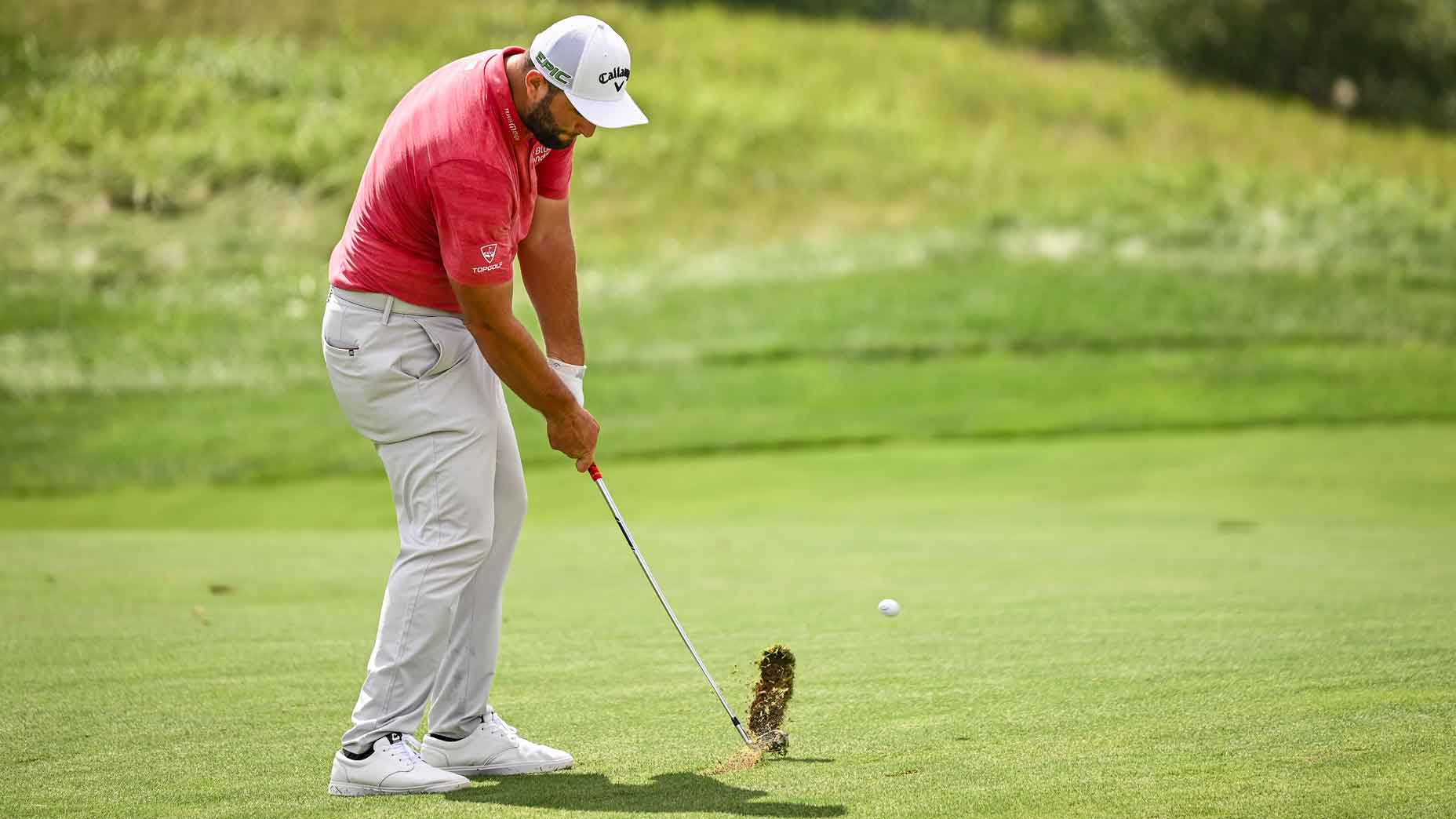
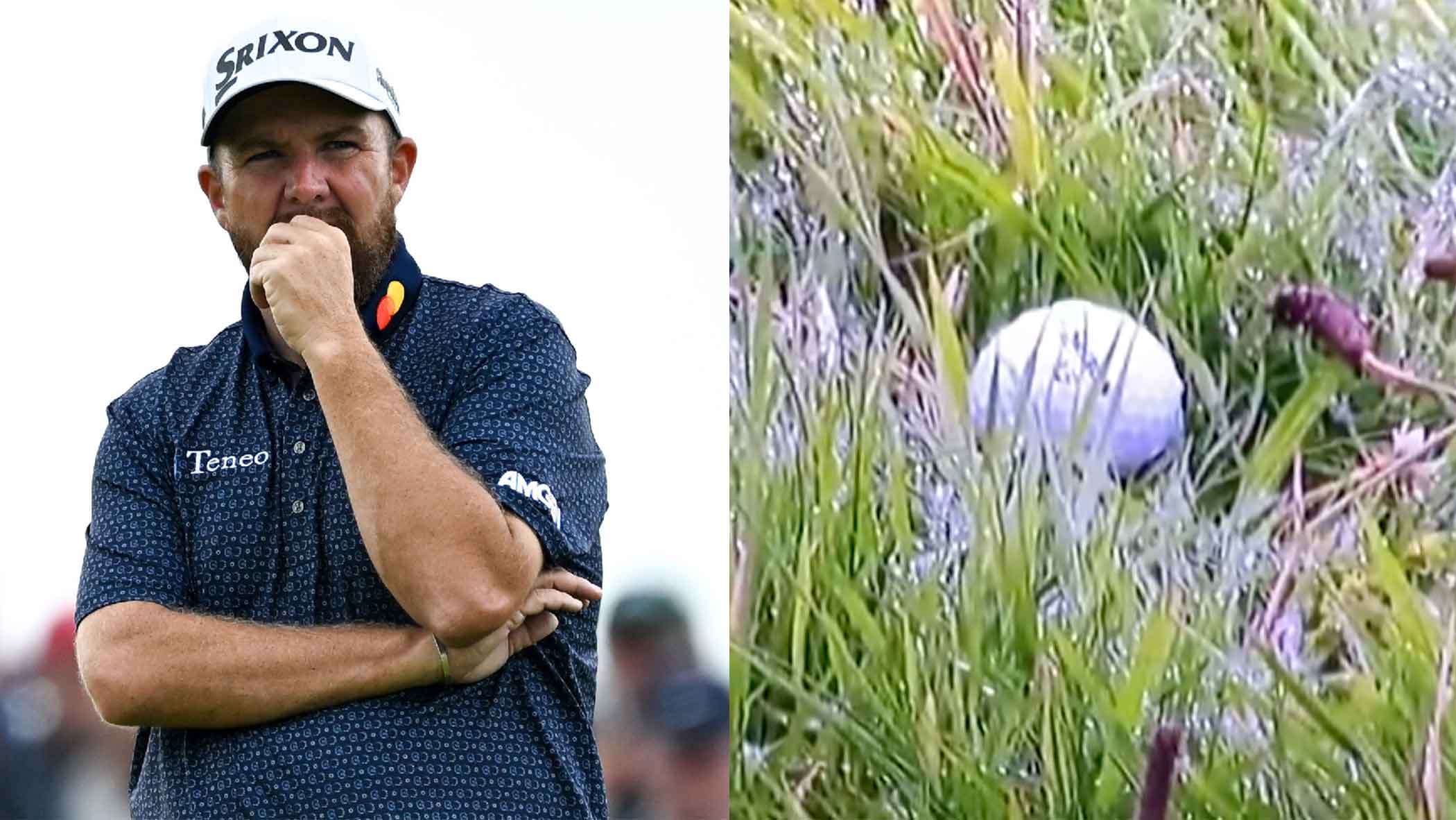
We take you to the native area left of the fairway on the par-5 12th hole at Royal Portrush, where crowd favorite Shane Lowry, one under for the tournament at the time and very much in stalking distance of the leaders, was preparing to play his second shot. As he sized up the challenge that awaited him in the thick, wet grass, Lowry nestled his club behind his Srixon, drew his club back and took a practice swing, brushing the grass just left of his ball.
A moment after Lowry’s club bottomed out in the grass, his ball moved ever so slightly. Lowry, not noticing the movement (he later said), stepped out of his address, then stepped back in and hit his shot in earnest — although not all that effectively. From the sticky lie, he could advance his second shot only 144 yards into a fairway bunker up the left side of the hole.
After that swing, the NBC/USA Network broadcast cut away from Lowry but soon after revisited his practice swing in the form of a zoomed-in replay. As the clip played, NBC commentator Dan Hicks weighed in.
“It almost looked like this ball moved as he took a swipe here,” Hicks said. ”You can see there’s a lot of moisture — yeah, it did move. It oscillated back.”
Joining Hicks in the live analysis was R&A rules official Charlie Maran, who said: “I think we’ll have to find out whether or not it’s deemed that Shane actually caused this ball to move. The grass is wet, the ball may have been on a slope. We just have to work out whether or not—”
Here, Hicks interjected, saying: “It seemed like the timing of it was that there was no doubt that the ball moved after he made this swipe. I don’t know. It was close like you said.”
A few minutes later, Hicks and Maran picked up the Lowry debate again, with Maran saying, “If it is deemed that he caused this ball to move then there will be a penalty.”
Hicks asked Maran for his opinion on what went down.
“My personal feeling is that it looks quite incriminating,” Maran said. “But let’s just wait and see what Grant Moir [director of the R&A rules department] has to say about that.”
The episode called to mind a lower-stakes version of the Dustin Johnson moving-ball controversy that rocked the final round of the 2016 U.S. Open at Oakmont. In that situation, USGA officials — with the aid of video evidence — deemed that Johnson, the leader at the time, caused his ball to move on the 5th green but did not alert him of the infraction or penalize him until after the round had concluded. (Johnson won by three.) The USGA later apologized for the lateness of the ruling, allowing that it created “unnecessary ambiguity for Dustin and the other players, as well as spectators on-site, and those watching and listening on television and digital channels.”
On this Friday near the tip of Northern Ireland, the claret jug wasn’t in the balance just yet, but Lowry was just a couple of shots within the projected cutline. A penalty — which would cost him two strokes — had the potential to be deeply consequential. And yet Lowry was oblivious to the fact that he was in the middle of a rules controversy. It wasn’t until he was pacing down the fairway on the par-4 15th hole, he said after the round, that the R&A notified him that his practice swing was under review and that they want to consult with him about it following his round. Seemingly undaunted, Lowry birdied that hole, then parred his way in, thinking, for the time being, that’d he just shot a stellar one-under 69.
As Lowry played out his round, chatter about the ruling had continued in the booth. At one point, Maran, the R&A official, said, “We’re not sure of what the outcome will be and whether or not TV evidence will create an issue for Shane leading to a penalty of which he’ll need to know about before he finishes his round.”
After Lowry had holed out on 18 and before he made his round official with an inked signature, he reviewed a replay of his practice swing with a rules official.
Penalty? Did Shane Lowry cause his ball to move? #TheOpen pic.twitter.com/v0UMwhIx36
— Jason Krump (@JasonKrump) July 18, 2025
Lowry said he felt the R&A had already made the decision to penalize him but he went through the process of examining the reply anyway. “They’re trying to tell me if it doesn’t move [as viewed by] the naked eye, if you don’t see it moving, it didn’t move,” Lowry said. “I told them I definitely was looking down towards the ball as I was taking that practice swing, and I didn’t see it move.”
That Lowry didn’t see any movement could have been crucial under a rule instituted in 2017 that limits the use of slow-motion replay in rule decisions. That rule reads: “If the committee concludes that such facts could not reasonably have been seen with the naked eye and the player was not otherwise aware of the potential breach, the player will be deemed not to have breached the Rules, even when video technology shows otherwise. This is an extension of the provision on ball-at-rest-moved cases, which was introduced in 2014.”
But Lowry said even though he didn’t detect any movement, he accepted the penalty because he didn’t want to risk having critics pillory him for trying to sidestep the rule book. “I can’t have my name talked about or tossed around like that, and I just get on with it,” he said. He added that the ruling is “hard to take,” but that he’d just have to “dust myself off and get out there tomorrow and give it a go.”
The R&A later explained the particulars of the ruling in a statement that read in part: “In these circumstances there is a one stroke penalty and the ball must be replaced. However, as the ball was played from the spot where it was moved to, the player played from a wrong place and incurs a total penalty of two strokes.”
Asked if the ruling felt unfair, Lowry said, “A little bit, but I’m not going to — if the ball moved and I caused it to move and it moved, it’s a two-shot penalty. The last thing I want to do is sit there and argue and not take the penalty and then get slaughtered all over social media tonight for being a cheat.”
Lowry also was asked how he felt about being notified of the situation three holes after it happened.
“I don’t know to be honest,” he said. “Like I always say, I’m going to have to sit back and kind of think about this now before I go to bed tonight. Obviously you want to know if you’re on the cut mark, but I went from feeling like if I can make two or three birdies on the way in, which I felt like 15 and 17 were good chances, that I can push up that leaderboard. And then all of a sudden I’m playing 16, 17, 18 feeling like I’m on the cut mark, even though I was very happy to birdie 15. That was a big birdie for me after what happened.”
He added, “I’m just going to have to take it. It’s a bad break. And move on.”
Lowry is at even par for the tournament, 10 back of leader Scottie Scheffler. On Saturday, he will play alongside Jon Rahm. They go off at 6:30 a.m. ET.