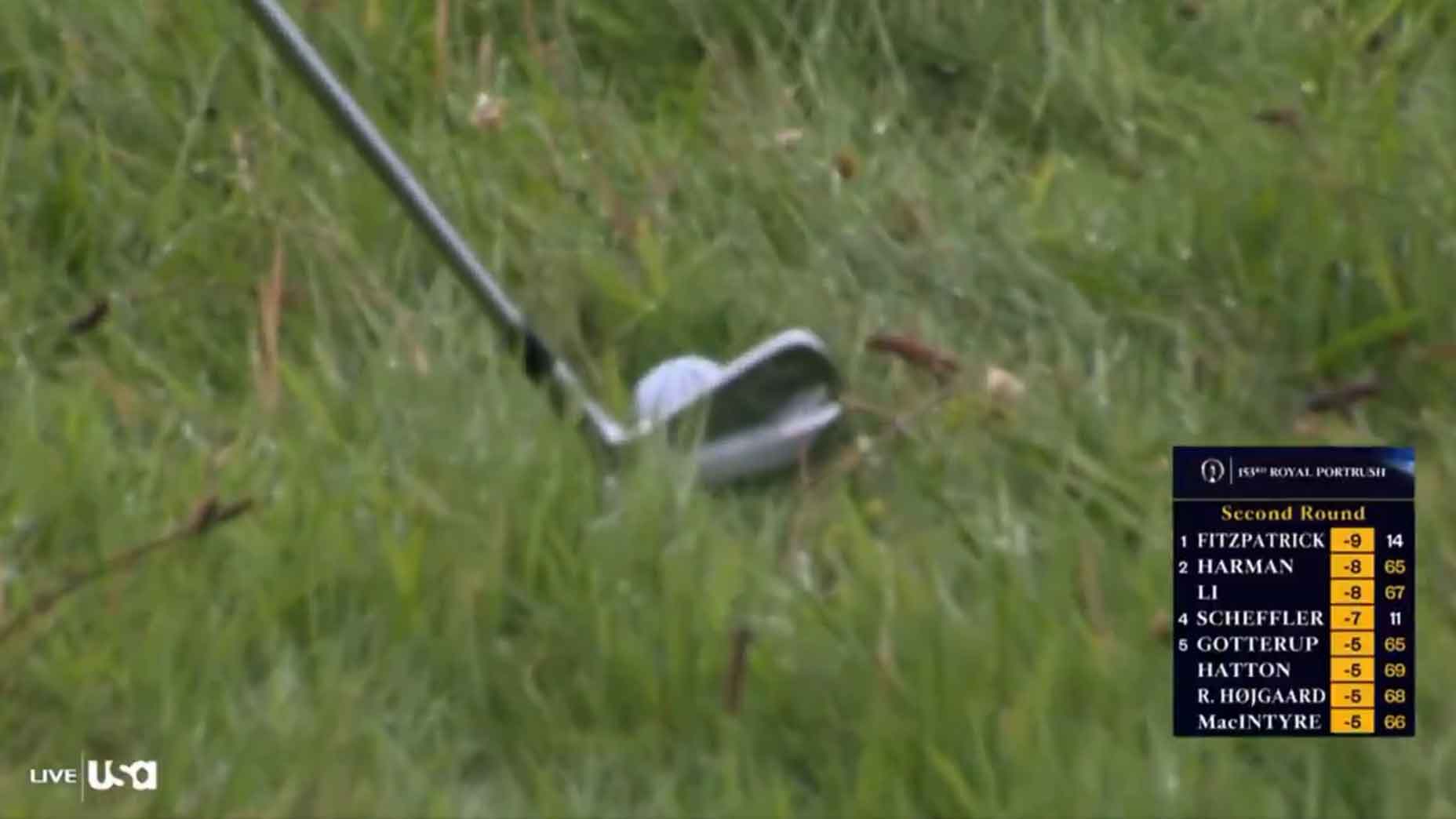
Shane Lowry was assessed a controversial two-stroke penalty on Friday at Portrush.
USA
PORTRUSH, Northern Ireland — Inside the scoring tent, Shane Lowry, his playing partners and rules officials reviewed the footage. Outside the scoring tent, a crowd had begun to gather, managers and TV reporters and, before long, players who’d teed off one and then two groups behind the threesome of Lowry, Scottie Scheffler and Collin Morikawa. Around the corner, a growing scrum of reporters gathered. Everyone everywhere was trying to figure out the same thing:
What are we going to do about this?
Ultimately the news emerged — two-stroke penalty — and Lowry emerged a few seconds later, understandably frustrated and still unsure of whether he could have handled any of it differently.
Every sport has its rules quirks and, increasingly, uncertainty surrounding the use of instant replay. But the Lowry incident spoke to three murky rules questions. Let’s buzz through ’em.
Camera? Or no camera?
Golf tournaments are not NFL games, where 4k cameras can capture multiple angles of every player on every play. Nor are they tennis matches, where automated line-calling eliminates plenty of gray area. Instead the action takes place over several hundred acres. The players hike several miles. They hit golf balls into odd places. And cameras follow where they can — which certainly isn’t everywhere.
Questions remain, then, about where and when to use replay to make rulings. Had Lowry not been on camera (and even more specifically, had a zoomed-in shot of Lowry’s golf ball not been on camera) neither he nor anybody around him would have ever known and we would have moved on with our day. Instead? Investigation time. And just enough information to be dangerous.
“I was in there with the rules official and wasn’t arguing my case, but I’m disappointed that they don’t have more camera angles on it,” Lowry said. One camera angle can be more confusing than clarifying — anybody who has ever wondered what a “catch” is or whether someone got a first down can relate — and so it’s tough to police things consistently.
Golf’s governing bodies have tried to address this; a 2017 decision limited the use of video review “when video reveals evidence that could not reasonably be seen with the ‘naked eye.'” Their cited example is a player who unknowingly touches a few grains of sand in a bunker. If the player couldn’t have reasonably known, it’s not a penalty. At the beginning of 2018 another rule took effect: the game’s major pro tours would no longer accept calls nor emails from fans who felt they’d spotted rules violations. There’s gray area here, too: who spotted Lowry’s ball move? Was it a tweet?
There’s no clear answer here and Lowry’s press-conference uncertainty reflected that.
“They’re trying to tell me that if it doesn’t move from the naked eye, if you don’t see it moving, it didn’t move,” he said. “I told them I definitely was looking down towards the ball as I was taking that practice swing, and I didn’t see it move.” Case closed, right? But Lowry felt the officials thought he’d caused the ball to move and that he should be penalized, and he didn’t want to fight that too hard; the last thing he wanted to do was be branded a cheat.
“I’m still not sure, to be honest, whether it was or not, but I had to take the penalty because I can’t have my name talked about or tossed around like that, and I just get on with it,” he said.
When do you break rules news?
There’s no good time to get bad news, and breaking this specific type of bad news — we think you might have broken a rule, though we’re not sure — is a particular lose-lose situation. Tell him in real time and you run the risk of affecting his mindset and play. Tell him later and you run the risk that he would have played differently had he known his score was two strokes higher.
“I didn’t know anything happened until walking up the 15th fairway and then the rules official came over and told me that there was a possibility the ball moved on the 12th for my second shot,” Lowry said. He’d assumed he was at one under par for the tournament — suddenly that wasn’t the case. A looming two-stroke penalty would have him at one over par, which wound up as the cut line.
“Obviously then I feel like I’m on the cut mark then, which is not very nice.”
Lowry birdied 15 and he parred his way in to finish safely inside the cut and book himself two weekend tee times. Post-round he admitted that he wasn’t sure, either, what the correct approach should be.
“I don’t know, to be honest. I’m going to have to sit back and kind of think about this now before I go to bed tonight. Because obviously you want to know if you’re on the cut mark, but I went from feeling like, if I can make two or three birdies on the way in, which I felt like 15 and 17 were good chances, that I can push up that leaderboard. And then all of a sudden I’m playing 16, 17, 18 feeling like I’m on the cut mark, even though I was very happy to birdie 15. That was a big birdie for me after what happened.
“But yeah, I’m just going to have to take it. It’s a bad break. And move on.”
This does seem like an answer with a clearer, if imperfect solution: the sooner the better. If you think it’s a penalty and you’re going to tell him anyway, you may as well do so as quickly as reasonably possible.
Wait — two strokes?!
This is where, in my view, golf’s rules seem to stray from the boundaries of common sense. Because Lowry was deemed to have moved his ball but didn’t replace it, he was penalized two strokes. But why?! If Lowry didn’t know the ball moved, he couldn’t have known to replace it.
you can talk me into one stroke but it seems sort of stupid that this is a TWO-stroke penalty pic.twitter.com/ghahisZU6s
The solution here seems pretty simple: If you cause the ball to move, you count it as a stroke. Tacking on another when there’s no way you could have known in real time? That feels like double jeopardy and unnecessarily penal.
In reality, nothing in golf’s legislation ends up being “pretty simple” when you consider edge cases. But why on Earth would hitting the ball on purpose count as one stroke but hitting it by accident count as two?!
There’s a reason the Rules of Golf have so many pages.
Dylan Dethier is a senior writer for GOLF Magazine/GOLF.com. The Williamstown, Mass. native joined GOLF in 2017 after two years scuffling on the mini-tours. Dethier is a graduate of Williams College, where he majored in English, and he’s the author of 18 in America, which details the year he spent as an 18-year-old living from his car and playing a round of golf in every state.