DD: This may be kind of a stupid question, but, like, if you turn your brain off completely and just swing the golf club, what happens?
JS: It’d be horrendous. Because if you said, don’t think and just swing, I’ve never actually played like that. I’ve always had a manipulating feel through my backswing — just in the backswing — and then from there it’s “Be an athlete and hit the shot.” But if I think about nothing, I get all sorts of messed up.
DD: What’s a big difference in the golf you guys play on Tour versus what amateurs are playing at home?
JS: Some of it is the pins, but also some of these courses are so hard. On those harder courses you’ll see such a difference in score. At Muirfield Village guys can shoot six-, seven-under rounds, but you’ll see guys shoot 79, and you’ll never see that anywhere else, just because you’re even more penalized on your misses. But, for the most part, guys are missing in the fat part of the green, they’re not making a ton of bogeys, they’re taking advantage of par 5s and some of the wedge holes. Most every golf course we play we’ll sit there and say, okay, there’s eight birdie chances today. You might steal one somewhere else, but there’s eight that I’m looking at where I’m going to be more aggressive, and the others you want to be in the fat part of the green, you make par, maybe you make a long putt. That’s where the separation is. When we play games at home — I play with Scottie [Scheffler] quite a bit [in Dallas] and we play with guys that are anywhere from a plus-two to a two handicap, and the separation isn’t what it would be if we were playing out on Tour just strictly because of pin locations.
DD: Who are these guys that you find to play with at home?
JS: [Laughing] Some of them you don’t ask what they do, some of them I find out what they do later. But we’ve got a good group of guys. It’s fun. And it’s awesome because you play these games and, obviously, if you’re playing with Scottie, you’ve got a pretty good gauge on where you are compared to everyone else. So that’s helpful.
I can kind of forgive the past. I can be pumped about what I’ve done. As long as I stay in that mindset, I do believe that good things are coming.”
DD: What was the 2025 season like? You had a bunch of strong results — four top 10s and seven top 20s in 18 starts — but also you were frustrated by a couple of missed opportunities late in the season.
JS: After I had [wrist] surgery [in August 2024], I wasn’t really able to go full until almost January 1 [2025]. So I played a couple rounds in December, but it’s not like I had an offseason to work on things. Most of what I was working on was through the season last year. I was 25 percent of the way there, and then I felt like I got another 70 percent there by the time the season ended. But that final 5 percent is just tournament play, taking it to the course, the consistency level of it. The way I started to think about it was like it was smoking meats. Say it’s chicken: It can get up to 155 degrees really quickly, but that last 10 degrees takes, like, the same amount of time it took to get all the way up there. That’s a weird analogy, but it’s been fun to work on because once the feel and the performance matches, I know great things are coming. And it’s been a long time since I’ve been able to position the club this way. I’m not doing it every time, but I’m doing it some, and I’ll do it more and more as I continue to work on the right things.
DD: What’s the best golf shot you’ve ever hit?
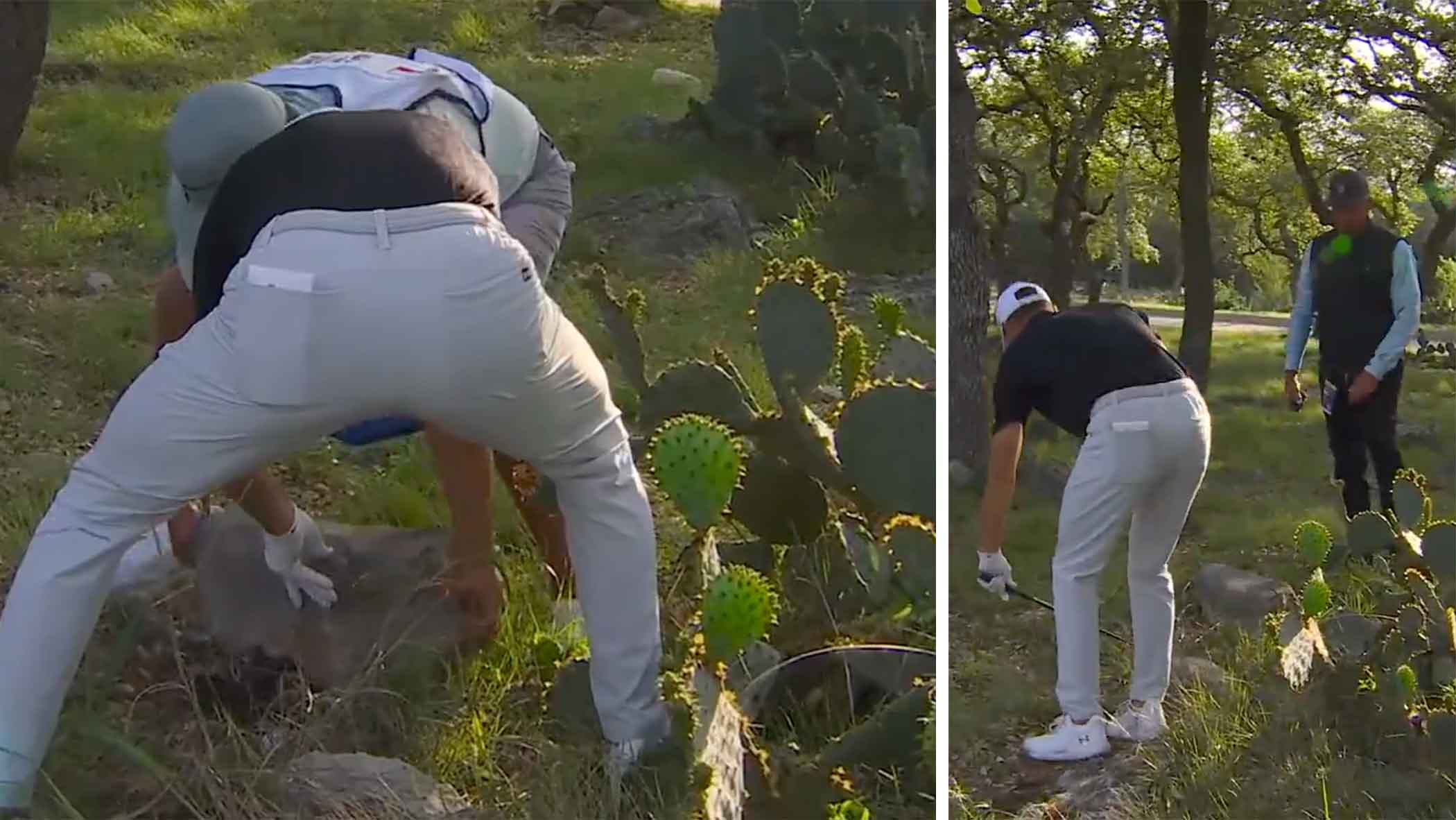
JS: I hit my 6-iron at the [2017] Open Championship at Birkdale [on the par-3 14th] after the conundrum on the previ- ous hole. [On 13, Spieth took a clever drop into the driving range and wound up getting up-and-down for bogey.] I stepped up and just hit a dead-straight rocket that almost went in and kind of took back control of the championship. I think that was probably the best shot — it was a hold 6-iron, just a little wind off the right, just starting to rain a little, and I just lined up right at the pin. And it came off and I was like, Oh, that’s not short, that’s not long, that’s not left, that’s not right — it’s gotta be good. It went to about three and a half feet, and then I went on a run from there.
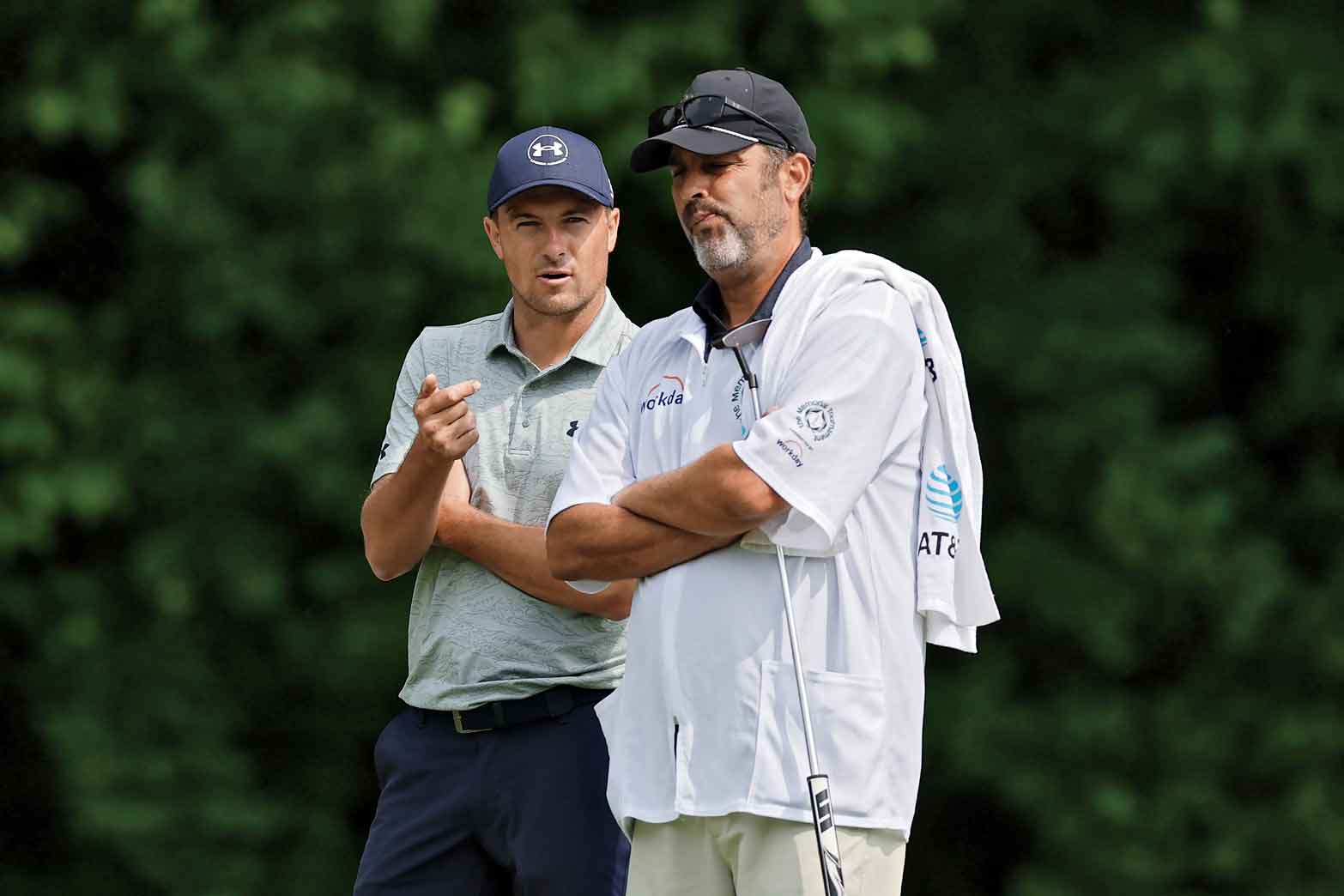
DD: That was special. And that entire back nine was the site of some all-time moments between you and your longtime caddie Michael Greller. How aware are you of those moments, of that dynamic and how fascinating it is to watch on TV?
JS: I mean, a lot of those moments come about without trying. Some of the most fun ones have been totally random. The one at that [2017] Open — the long putt [for eagle at No. 15] where I said “Go get that.” That [happened] because in the gym that week they were showing a lot of old Open Championships, and back in the ’70s these guys never got their balls out of the hole. They’d make a putt, their caddies would pull the pin out just in time for it to go in, and then they would pick it out of the hole. So that was in my head, in my subconscious. Also, the [next] tee was, like, 50 feet in the other way. I would have been going out of my way to go get [the ball]. That’s how “Go get that” happened.
DD: I didn’t realize it was a throwback move!
JS: It was a throwback move.
DD: What’s it like having set such a high standard at a young age, and always comparing yourself to past versions of yourself?
JS: It can be challenging. Like, I wouldn’t wish a couple years of the last five or 10 on people. Living in problem-solving mode, trying to figure out how to be — whatever. And knowing a lot of it is your mechanics is even more frustrating, because it’s not like everything’s fine and you know it’s just coming. But, at the same time, knowing that once I get the club positioned, the way my DNA is, the way I want it to — the good things are right around the corner. Golf’s funny, right? I’m 32, so I could play at a very high level for another 10 years, and that’s a long time. That’s a full career for almost any other sport. So I can kind of forgive the past. I can be pumped about what I’ve done. I can forgive the times that were hard and just be forward-focused with some scar tissue that can help. So, as long as I stay in that mindset, I do believe that good things are coming.