The past 12 months had a little of everything — a career Grand Slam, Ryder Cup chaos and so much more. With 2026 on the horizon, our writers look back at the most memorable moments from 2025 and explain why they mattered.
No. 15 — The zero-torque putter movement | No. 14 — ‘Happy Gilmore 2’ takes golf world by storm | No. 13 — Joaquin Niemann’s big 2025 (and crucial 2026) | No. 12 — J.J. Spaun slays Oakmont | No. 11 — The Internet Invitational | No. 10 — Jeeno Thitikul’s record year | No. 9 — Tiger Woods’ next role | No. 8 — Tommy Fleetwood breaks through | No. 7 — The birth of TGL | No. 6 — Keegan Bradley’s big decision | No. 5 — Europe wins another Ryder Cup
Stories of 2025, No. 3: The Bethpage Buffoonery
When Ryder Cup Saturday at Bethpage devolved from a competition into an internet comments section, I thought I might be falling ill.
As the temperature rose outside the ropes on Saturday afternoon, I felt my stomach churn, my head pound, my knees ache. For a second, I thought I was coming down with the flu — the product of too many early mornings on crowded shuttles. But then I charged up the hill next to the 18th green and realized I was feeling better, which was when it occurred to me I might in fact be having a somatic response to the ugliness happening around me. My brain hadn’t realized yet, but my body was feeling rage.
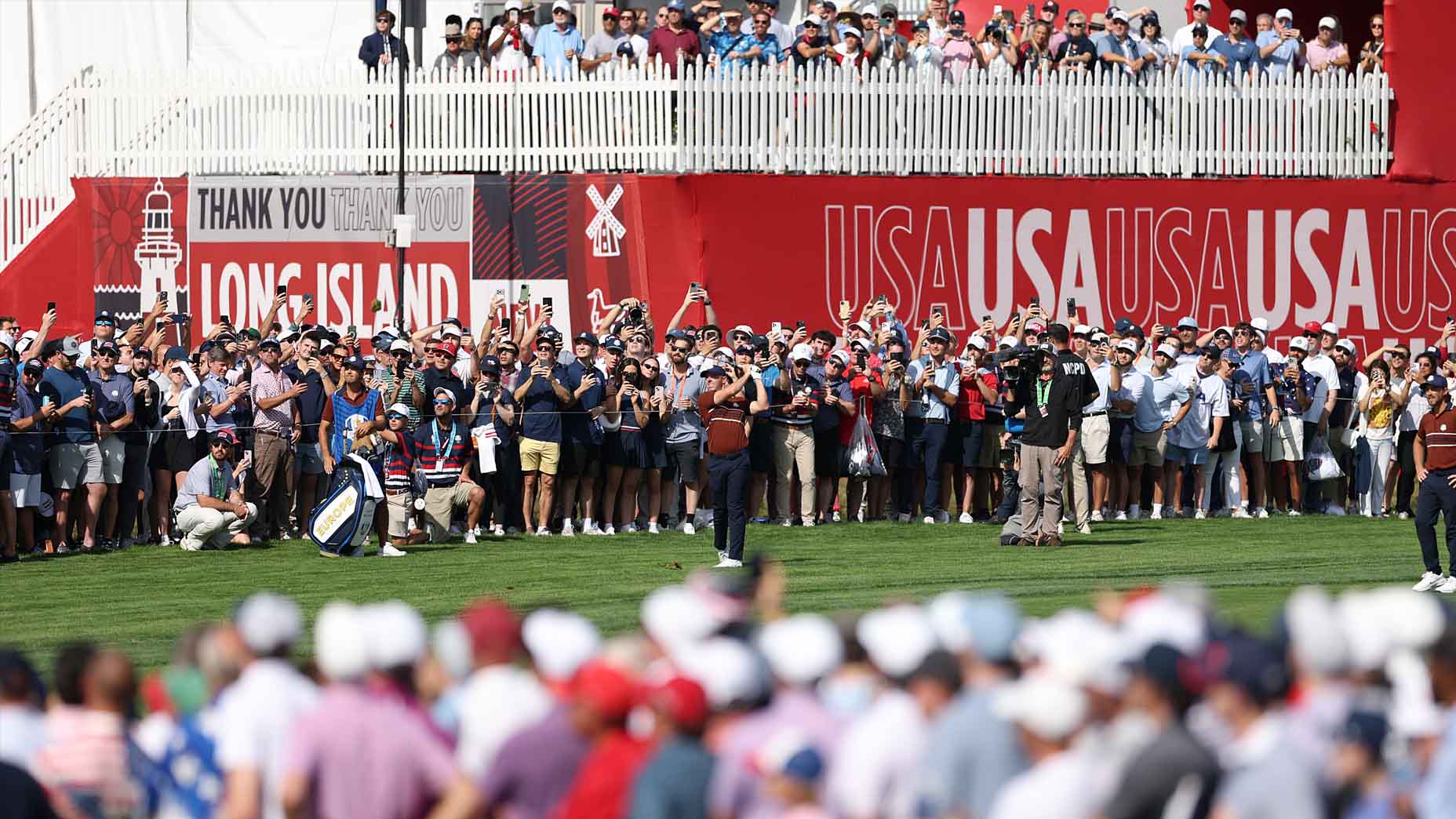
The source of my fury needed no explanation to those watching the Ryder Cup. The combination of uncompetitive golf and abundant access to alcohol had supercharged the frustration flowing through an already restless crowd and channeled it toward the European side’s most dominant player: Rory McIlroy. One off-hand comment about Rory’s professional and personal failings became five, one fan became 15, and one McIlroy birdie became 50 (or so it felt). For two hours, the player responded to the vitriol with a metaphorical middle-finger back to the crowd (and then, at one point, a literal one). And, for two hours, the crowd responded by going even lower.
I’d spent six years counting down the days to the Ryder Cup at Bethpage. The biggest show in golf was coming to my home course, not far from my hometown, at a venue I thought represented everything good and decent about the sport. It was supposed to be one of the highlights of my career, and it’d taken all of six hours on Saturday afternoon for a group of chuds who couldn’t tell the Red Course from a stop sign to tarnish the place’s reputation for good.
I remember returning home from the golf course on Saturday evening and feeling exhausted in a way I could not explain. As I recounted the wild afternoon to my family, I heard myself list every conceivable culprit for the crowd meltdown — the fans, the golfers, the PGA of America, the ticket prices, the course setup, the competition, the psychology of crowd behavior. But I was leaving one notable villain out: Bethpage.
By that point, the internet had no shortage of provocateurs willing to call for Bethpage’s removal from all future golf tournaments for the way the crowd had treated the European team. Their comments represented the kind of thinly veiled golf classism and anti-municipal elitism that I have long viewed with open contempt — a shrink-the-game worldview that the real Bethpage railed against with every fiber of its being. But deep down, I knew my silence in response to these comments was the true source of my rage, because for once I had no counterargument. The crowd failures of Saturday had proved the elitists at least temporarily right: This version of Bethpage had no place hosting a major golf tournament.
Even now, these sentiments make me feel gross, but they bear repeating: The individuals responsible for the ugliest golf tournament in recent memory belonged to me. Even if they did not embody the ethos of my home golf course, they were locals by proxy. There is no meta-analysis of Bethpage’s failings without a much simpler launching off point: Those bad actors were idiots, and there seemed to be many more of them at Bethpage than anywhere else in the golf world. As someone who loves Bethpage, I am ashamed.
But I’m also angry. Today the Bethpage Ryder Cup may be viewed as a regrettable blip in the rearview mirror — a gruesome piece of roadkill best forgotten about next to the endless strip of asphalt ahead — but the rage I felt on that Saturday evening still lives inside of me. I’m not willing to blame the ugliness we saw at Bethpage on the lazy stereotypes of New York sports fans or the “inherent issues” of hosting at a municipal venue, and it concerns me that I might be alone.
The truth is that the Bethpage Ryder Cup wasn’t a bug in the system. It was a feature of pro golf that has been allowed to fester for too long. The exact shape of the problem varies by location, but its general dimensions never change: A heavily oversaturated hospitality environment; an overpriced ticketing system; a “tournament experience” encouraging chaos and consumption; a security strategy overwhelmed by the logistical challenges of golf; a crowd addicted to social media and a small group of bad actors stoked by the uniquely antisocial instincts of achieving viral fame. I saw this environment at Bethpage, but also at events across the golf world over the last several years: the WM Phoenix Open, the Memorial Tournament, LIV Bedminster, the PGA at Valhalla — and in many other places where a few good samaritans or an unheralded tournament volunteer helped restore order before the crowd took hold.
To be clear, this environment is a great way to make a ton of money hosting a golf tournament — as I suspect the PGA of America’s next batch of financial filings will show us. But it is also a means to a large, loud, drunk, entitled and easily peeved mob shouting increasingly deranged insults at one of the best golfers in the sport’s history in the hopes of gaining a shread of internet microcelebrity — as I suspect anyone who watched the Bethpage Ryder Cup now intuitively understands.
I hope the great majority of golf fans would agree this outcome is unacceptable, even if they, like me, have occasionally delighted in the grainy cell phone video of a tete-a-tete between a drunk teenager and a curmudgeonly golfer. The fiercely meritocratic, dreamily escapist nature of truly great tournament golf has attracted people to pick up the sport for generations. It is also the exact component of tournament golf that disappears the second a tournament devolves into ugliness. To lose this spirit to the engines of profit would be to lose perhaps the sport’s most powerful microphone to the regular world.
Of course, we are not in danger of losing tournament golf altogether. Most golf tournaments (even the ones that have flirted with disaster) are still pleasant environments operated by people who love golf and feel a duty to uphold its traditions. Failures like the crowd at Bethpage are usually the result of the implosion of several safeguards: organizers who spent years sweating the minutiae of security enforcement and fan behavior; tickets, which are not so prohibitively expensive as to strain the value proposition of rational behavior; and other fans, who police the worst actors among us and are, by the basic principles of tournament golf, rooting for most players and against none of them.
These people have served as the last line of defense for tournament golf forever, and will be the unsung heroes of every truly great tournament until the end of time. But these people are not enough. Without a shared commitment to dignity from golf writ large, the organizers and good samaritans will be the only line of defense against most tournaments turning into the ugliness at Bethpage.
One specific opportunity for improvement exists on social media, which lapsed into a patronizing echo chamber of mostly faux outrage in the wake of the ugliness at Bethpage. Maybe I shouldn’t be surprised by the outrage, or by the almost instant rush to virtue-signal or sensationalize, but I am disappointed by it. There is no reward for thoughtfulness on golf social media, and in the world of anger-juiced algorithms, there might even be a penalty.
I wonder how many golf fans — even the chronically online ones — know how social media is altering their perception of the things they care about. The great gift of instantaneous connection has come at the explicit expense of nuance, flattening our experiences from a diverse range of opinion into an uncurious binary. Successful social media channels (which is to say: the ones with big followings) are those willing to engage on simple terms: “The American Ryder Cup team made a few strategic errors and is getting outplayed” is bad; “Fire Keegan Bradley” is good; and “Keegan Bradley is an unbelievable moron” is best.
A strange side effect of this binary is the velocity with which we have agreed to adopt it. We are faster to anger, to outrage, to “dunking on” our enemies than ever before. We are worse at listening and disagreeing. Civility is disappearing, and righteousness is taking its place.
We should all do better — either as the people making content or the people consuming it — to be curious instead of reactionary, and to reject those outright whose sole role in golf’s discourse is inflammatory. Perhaps outrage is the direction of the world, but it does not have to be the direction of golf.
None of this is to say that outrage is inherently bad. If you saw the videos and posts that came out of Bethpage and were mad, that’s a good thing. Golf is a unique sport precisely because its participants treat one another with a sincere sense of respect and dignity. The Bethpage Ryder Cup was severely lacking on both accounts — and outrage can be a particularly helpful emotion in ensuring history does not repeat.
But the only path to ensuring Bethpage exists only in our rearview is action, and noticeable changes have been sorely missing from the golf world in the months since the Bethpage embarrassment. Is anyone thinking about what went wrong at Bethpage, and how to ensure it never happens again? Is anybody soul-searching about what was lost in pursuit of the most expensive tickets and most expansive hospitality build-out in golf history? What will change at the Ryder Cups in 2027, 2029, and all the years beyond to protect against this outcome? How will the players be protected? And how about the fans?
Golf possesses the power and the influence to find these answers and live by them. But I wonder if the hard work of protecting a sport isn’t as easy — or as profitable — as a few angry words into the social media abyss.
The truth is that golf as we idealize it is hard. Civility requires effort. It requires leaders. And it requires individuals who are committed to upholding civility even when it is personally inconvenient. Regrettably, civility also requires that we pursue it with intention — even for the people we feel deserve it least, and, in fact, because of them.
When I began working in the golf industry as a 22-year-old Long Islander, Bethpage was the only place where I felt truly at home — surrounded by people who did not mind how I wore my shirts, which logos were stitched onto my hats, or what my bank account looked like. I learned quickly that Bethpagers felt a white-hot devotion to golf at its core — the challenge, the time outdoors, the competition within. I have learned at Bethpage that golf’s commitment to high-minded ideals like civility is remarkable precisely because there is no income requirement to practice them.
I still believe these virtues about Bethpage, even after the ugliness we witnessed in September. I still believe them about golf, too. But these rising temperatures in our sport have long been a symptom of a much more insidious disease.
After Bethpage, it’s time for the fever to break.
You can reach the author at james.colgan@golf.com.