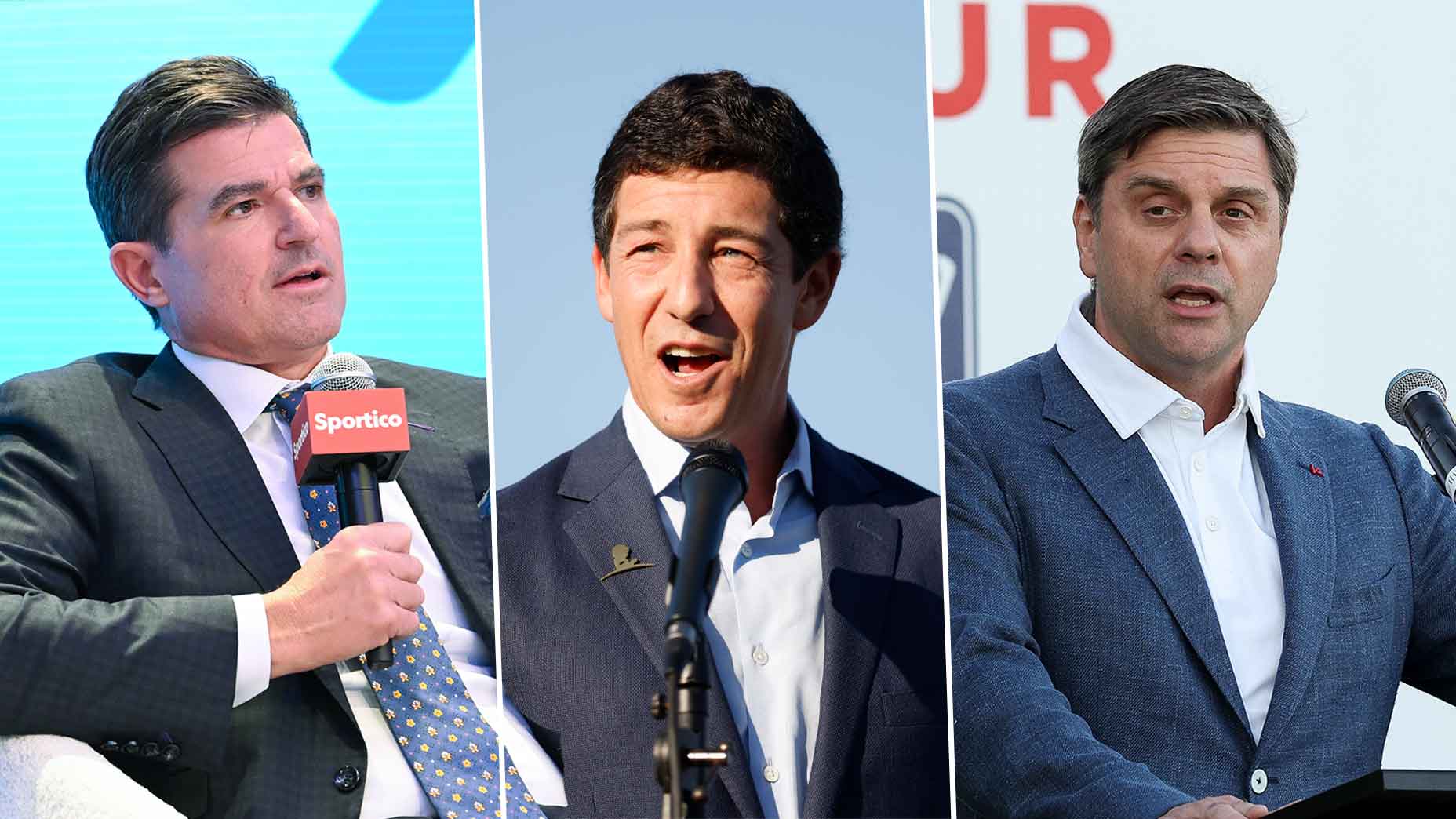
The future of pro golf will be decided in large part by these three men.
Getty Images
The past 12 months had a little of everything — a career Grand Slam, Ryder Cup chaos and so much more. With 2026 on the horizon, our writers look back at the most memorable moments from 2025 and explain why they mattered.
Biggest golf moments of 2025 No. 2: New sheriff(s) in Town
Golf fans would be forgiven for rolling their eyes at another year gone by without meaningful progress on reunification in the men’s game or greater rating metrics from the women’s game. On those fronts, 2025 wasn’t sexy at all. But the year yielded far more momentum toward actionable, tangible, meaningful change in pro golf than it appeared. And why? The answer is simple: Leadership.
Almost every meaningful pro golf tour — sparing the DP World Tour — has new leadership in tow as we move toward 2026. For the LPGA Tour, Craig Kessler signed on as the new commissioner after stints at the PGA of America and as an executive in the startup world. For LIV Golf, Scott O’Neil joined the fold, hoping his Process-era stint at the helm of basketball’s Philadelphia 76ers would provide meaningful wisdom for a golf tour still finding its footing. And for the PGA Tour — no doubt the biggest of those hires — the new commander-in-chief was Brian Rolapp, Roger Goodell’s long-time right-hand man and the NFL’s long-time media czar, who was brought to grab the reins from outgoing (and embattled) commissioner Jay Monahan.
It would normally feel wrong to rank executive hires as one of the biggest stories of 2025, but there is some trust included in that lofty ranking. Pro golf’s previous generation of leadership changed many things, but its final stretch at the helm was marked by a period of stagnancy — the battle lines drawn, the rules written. The months since those leaders were replaced have revealed a renewed sense of vigor around reimagining golf as we know it and as we watch it. Sometimes, new leadership can be about a lot more than changing the drapes.
Rolapp joined the Tour in the middle of the summer, shook a lot of hands and started charting a new path. The biggest change came in the form of the Future Competitions Committee — a brand-new group tasked with cultivating the ideal future shape of the PGA Tour, and enlisting Tiger Woods as its leader. We don’t know everything the so-called “FCC” has been cooking up, but we do know it begins with a push toward creating scarcity. In short, we believe that will mean fewer, bigger PGA Tour events on the annual calendar. For inspiration, Rolapp needed to look no further than the importance of the upcoming week of the NFL schedule — Week 18 — where nearly every single game is significant for playoff seeding, draft positioning, or postseason dreams. Without such a (comparatively) short and small season, these games might not feel (and might not be) as significant. Sometimes, less really is more.
O’Neil had to play a slightly different ballgame. More than any competitive changes, O’Neil first needed to establish himself as a fresh face for the upstarts. His predecessor, Greg Norman, had worn patience thin with just about every governing body in the sport, ratcheting up the tensions between the new league and its competitors. O’Neil’s had to mend relationships — particularly with the Official World Golf Ranking, in pursuit of major championship eligibility — and was able to work with the USGA and R&A to create extra exemptions into their major championships for LIV players. O’Neil has acknowledged he has a relationship with Rolapp, as minor as it may be, which offers the faintest hope for some unity in the men’s game. He’s also debuted a new calling card for the role he hopes LIV will play in the golf landscape: Complete, not compete. But whether or not that happens, O’Neil is the captain of the LIV ship and is much more available as a public-facing leader than his predecessor.
Like Rolapp, Kessler joined the LPGA in the back half of the summer, coming over from the PGA of America, where he was the Chief Operating Officer. He showed up in time to oversee much more of the regular season than Rolapp could, and has made himself plenty available to golf media. Take his recent conversation with GOLF.com’s James Colgan, where he discussed shifting media trends and the “attention economy.”
“Watching how the future generation of LPGA athletes are consuming media and entertainment has been completely eye-opening for me,” Kessler told Colgan. “We’re thinking about winning our share of the attention economy, and we are making the right moves in the right way in order to succeed.”
In his few months on the job, Kessler landed the Saudi PIF as a new tournament sponsor, and also locked in a better LPGA broadcast starting in 2026. (50% more cameras, drone footage and Trackman-improved shot-tracking.) It’s clear his narrowed gaze on a few, key initiatives is popular with LPGA pros. And that’s really why these hires, collectively, are such an important story from 2025. They seem to have a lot of support.
O’Neil has world ranking points as high as anything on his list of priorities, and it would seem LIV will check that box soon. Rolapp arrived with a promise to make “significant change,” and only a few months later we’re talking about a Tour schedule that doesn’t begin until February. That won’t please everyone, but it will at the very least start moving the train out of the station and headed in a new direction.
This content is available only to InsideGOLF members. Log in to continue watching, or join InsideGOLF for full access.
Sean Zak is a senior writer and author of Searching in St. Andrews, which followed his travels in Scotland during the most pivotal summer in the game’s history.