Welcome to Clubhouse Eats, where we celebrate the game’s most delectable food and drink. Hope you brought your appetite.
***
When Chef Mario Scordato isn’t making fresh pasta at his primary business, Pasta Bar, in McHenry, Ill., he’s working as a private chef at Bunker Hill Farms, a private golf resort about 60 miles northwest of downtown Chicago. As a part of that gig, he teaches cooking classes for guests — often coaching amateurs on the finer points of making fresh pasta at home. “The big surprise for people,” he says, “is how easy it is to make.”
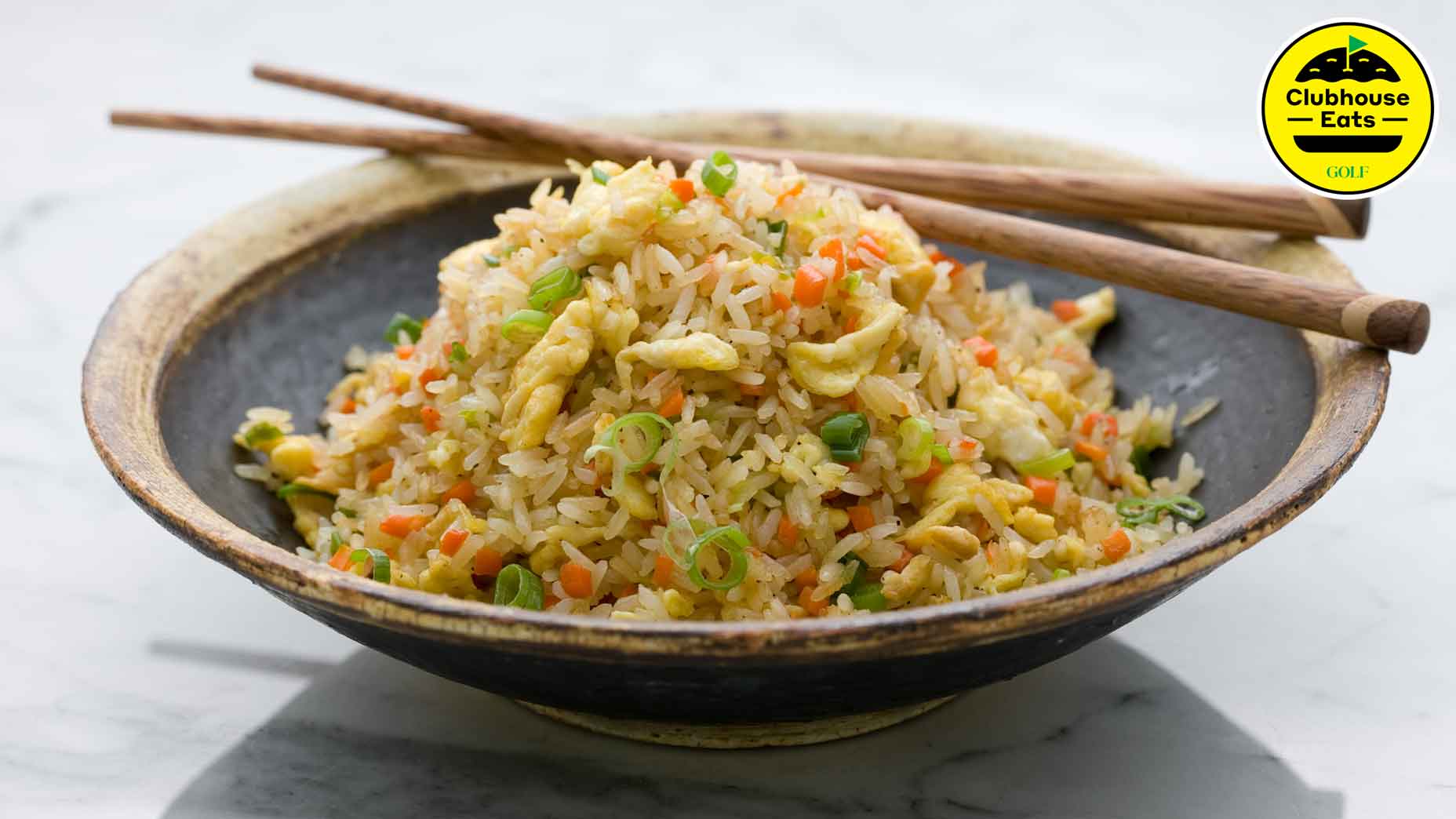
The same is true for cerrtain classic Chinese takeout dishes, like fried rice, which Chef Scordato often cooks at home for his family — though he’ll occasionally break out the ingredients for a cooking class on Asian takeout food at the resort, but only if guests request it. Fortunately for you, we asked the chef for his advice on cooking the quintessential Chinese side dish, and he obliged. That means you don’t need to book a stay at Bunker Hill Farms to learn his secrets. (You should, however, book a stay at Bunker Hill Farms just to experience the property’s unique golf course. But that’s another story for a different time.)
Fresh Isn’t Best
Most dishes benefit from à la minute cooking. Fried rice isn’t one of them. The starch in freshly cooked grains of rice is too pronounced, meaning it won’t interact with hot oil the way you want it to. “It tends to stick,” says Scordato. “It gets mushy. It just doesn’t work well.”
What does work well, so advises the chef, is day-old rice—or, at the very least, rice that’s cooked the morning of and allowed to chill in the refrigerator. “There’s so many dishes in so many different cuisines that are made to use up leftover ingredients, and fried rice is one of those,” he says. “So it works best if you use leftover, cooked rice.”
Fat Chance
If you’ve ever been to a teppanyaki restaurant (better known as hibachi here in the States) and you’ve watched the chef whip up a batch of fried rice on the flattop, you know that those delicious grains are anything but good for you. The amount of butter added to the mix is staggering.
But as you’ll see in Chef Scordato’s recipe (below), fried rice at home is at least marginally better for you — two tablespoons of a neutral oil isn’t the issue; it’s the six ounces of bacon that neutralizes some of the health gains. Nevertheless, when you’re the one wearing the apron, you can dictate the details. “You, as the chef, have control over one of the most important factors — the fat,” Scodato says. “Not only the amount that’s used, but the type of fat and the quality.”
Grapeseed or avocado oil are the chef’s preferred options, as they’re minimally processed, which means they’re the healthiest of the bunch.
Open to Interpretation
Speaking of control, fried rice gives home cooks lots of it, which is another appeal. “You can easily make it your own,” Scordato says. “Fried rice isn’t a dish with strict guidelines. It’s not a situation where someone will say, ‘Well, according to ancient Chinese tradition, it has to be these four things.’ It doesn’t matter. If there are things in the recipe that you like, great. If there’s things that you don’t, it’s very easy to substitute.”
Bigger *is* Better
Once you’ve decided on your ingredients and you’ve cooked the rice in advance, you’ll need the right vessel. Excellent fried rice is as much a product of what it’s cooked in as it is the ingredients used to make it. A large wok is the preferred choice, but it’s not a pre-requisite. A traditional skillet can do the trick, too, so long as it meets one criteria. “Thinking in the parlance of Jaws,” says the chef, “sometimes you need a bigger boat.”
The translation? The bigger the sauté pan, the better. “Just because it fits,” he says of all the ingredients, “doesn’t meant that it’s going to cook right in there.” You not only want a pan that can hold the rice and all of its accoutrements, but you want to make sure that there’s enough room for some open space once all of those ingredients are added. The air flow and extra surface area is what ensures that everything gets properly crispy.
Turning Up the Heat
And on that topic, the best fried rice offers an element of crunch, which can only be imparted when you crank up the heat. So, in the words of Chef Scordato, don’t be afraid to use it. “The less-experienced cook tends to use less heat than they need in a lot of instances,” he explains. “But if we’re wanting to get a really nice crisp and brown on our fried rice, we have to be willing to take the chance that we might make a mistake and take it too far.”
Mario Scordato’s Favorite Fried Rice
Yield: 4 servings
Active cooking time: 20 minutes
Start to finish: 20 minutes
Ingredients:
2 tbsp. grapeseed or neutral oil
6 oz. bacon, medium dice
1/2 yellow onion, medium dice
1/2 cup peas
2 garlic cloves, thinly sliced
2 tsp. fresh ginger, peeled and minced
2 cups cooked and cooled long-grain rice
2 eggs, well beaten
2 tsp. soy sauce
1 tsp. sesame oil
1 tbsp. oyster sauce
Salt to taste
Ingredients for garnish:
2 scallions, green parts only, sliced thin on a bias
2 tbsp. sesame seeds, toasted
Preparation:
Heat a large nonstick saute pan over medium heat, add the oil, then the bacon, and saute until golden brown around the edges and almost crisp.
Add the onion and cook until softened, then add the garlic and ginger. Cook until the garlic and onion are lightly colored.
Increase the heat to high and stir in the rice, breaking it up with a wooden spoon or spatula. Cook until the rice is hot all the way through and golden brown in some spots.
Push the rice to one side of the pan. In the open space, pour in the eggs and lightly scramble. Once cooked, mix the eggs in with the rice.
Add the soy sauce, sesame oil, oyster sauce and salt to taste. Stir in the peas, and cook just until heated through. Taste and add more soy sauce, if necessary.
Sprinkle with sesame seeds and sliced scallions and serve.