I gained a ton of speed in one speed training session with Bernie Najar.
GOLF.com
Adding swing speed has become a bit of an obsession for me. Over the last eight months or so, I’ve dedicated tons of time to hitting the ball longer off the tee, and the pursuit is intoxicating.
You see, I’ve always known that I was leaving some meat on the bone when it came to my driving distance. But for the longest time, I just didn’t care. Driving accuracy was my specialty, and so long as I was hitting fairways, my lack of distance didn’t bother me.
The problem is that the lack of distance severely limited my upside. Despite being a low single-digit handicap for much of my adult life, I’ve never been able to reach my ultimate goal of getting to scratch. With a little more distance, though, that goal becomes much more attainable.
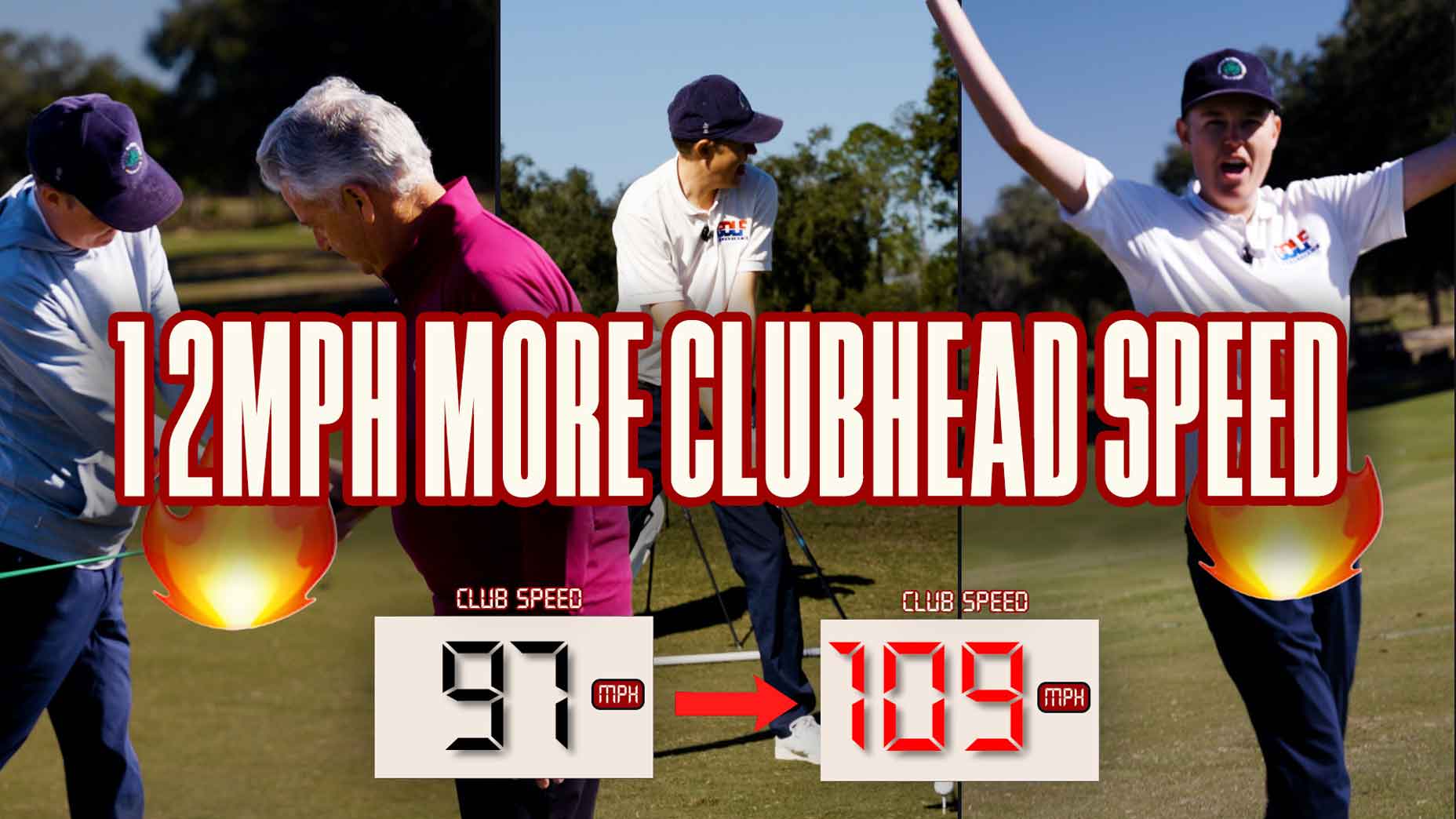
With dedicated time each week in the simulator (and in the gym), I’ve slowly increased my max clubhead speed. But I knew I needed more help. That’s when I called up GOLF Top 100 Teacher Bernie Najar.
Bernie is the perfect teacher to call when you need more speed. In addition to being the 2026 PGA of America Coach of the Year, he’s also somewhat of a speed guru. He’s worked with a handful of World Long Drive pros, including Kyle Berkshire, and knows just about everything there is to know about swinging fast.
At last winter’s GOLF Top 100 Teacher Summit, I got the chance to learn from Bernie firsthand as he took me through a one-hour speed session — and the results were incredible. With my first swing of the day, I was at 97 mph of clubhead speed. A little less than an hour later, I reached 109 mph.
Check out the video below to see how Bernie upped my clubhead speed, or read on for more.
How I gained tons of speed in 1 hour
1. Get loose
Like with any physical activity, it’s wise to stretch and get your body loose before you really ramp things up. That means plenty of stretching and partial swings to get the body firing the right way. If you don’t “turn the engine on” properly, you can’t expect to swing the club at your fastest speeds.
One stretch I did under Bernie’s direction helped maximize my rotational mobility. He gave me an exercise band and had me hold it taut out in front of me in my golf stance. Then, I made a nice, full turn to the top while keeping the resistance on the band the entire time.
2. Understanding my body
I’ve got extremely high arches in my feet, and it causes my knees to naturally bank in when I’m standing. Bernie noticed this immediately and prescribed a quick fix to fight against it: wearing a resistance band around my legs.
With the resistance band around my legs, he instructed me to push out with my legs during my swing. It made me feel like I was bow-legged, but in reality, it simply got my legs into a more neutral position.
“A lot of what we’ve got to do in your golf swing is create a better base to work within,” Bernie said. “When your feet are banked in, getting a little wider will help you push out a bit more.”
For anyone trying to pack on speed, understanding your body is crucial to maximizing efficiency.
3. Establish a baseline
During any speed training session, it’s important to make some swings early on at “normal” speed. For me, that was in the high 90s, with my “play speed” being at 97 mph.
This does a couple of things. 1. It helps you get loose with some normal swings and tells you how your body is moving. And 2. It establishes your baseline for the day.
4. Abbreviated swings
After those “normal” swings, we started getting into the speed session in earnest. One of the first tricks Bernie taught me was how to make powerful abbreviated swings.
With my trail foot back, Bernie instructed me to take the club back to parallel and then swing through impact, stopping the clubhead shortly after making contact with the ball.
“We’re not trying to go high speed,” Bernie said. “We are just trying to get energy to the clubhead at the right place.”
Despite making abbreviated swings, the radar showed my clubhead speed right around 80 mph for these swings, which shows just how much speed is generated in the hitting zone on every swing.
5. Crack the whip
As we made these abbreviated swings, Bernie dropped an analogy that I found quite instructive: “You have to know where to crack the whip.”
When you use a whip, you stop the handle rapidly when you want it to “crack.” This slowdown sends all the energy from the handle to the end of the whip, culminating in a satisfying “crack.”
The same principle applies when swinging the driver fast. If you watch elite players swing the club, you’ll notice that the handle actually slows down near impact. In doing so, they send all the energy to the clubhead, which helps maximize its speed.
“A lot of people just flail away in a speed session,” Bernie said. “We are trying to get the transfer of energy better.”
If you can master how to crack the whip efficiently, you can generate tons of speed without even looking like you’re trying.
6. Up the intensity
When you are speed training, you can’t stay in your comfort zone. If you really want to go fast, it’s important to increase your intensity.
“I’m a big believer in getting your intensity up,” Bernie said. “In your case, you need to get your heart rate up.”
Then, he asked me to do jumping jacks. It may sound silly to do some cardio work during the middle of a range session, but to hit the ball with max effort, you’ve got to get your intensity — and your heart rate — up.
7. Don’t worry about where the ball goes
One of the hardest things to do when speed training is letting go of the result. We are programmed to care about where the ball ends up, but when you are trying to increase your max speed, you can’t do that.
“One of the things Kyle Berkshire would tell you,” Bernie said. “If you are in a speed session, if you don’t have a big miss, you’re not going fast enough.”
Remember, speed training is not about helping you hit more fairways. It’s about training yourself how to increase your max speed.
8. “Low and slow” is BS
One of the most popular adages in golf is that you should take the club back “low and slow.” But if you are trying to hit the ball longer, that’s a load of BS.
To get the maximum amount of energy into the golf club — and generate more speed — it’s important to put that energy into the club as soon as possible.
“Putting more into the golf club means you really have to rev it up a little,” Bernie said.
9. Go past your comfort level
Speed training is not supposed to be pleasant. If you want to hit balls and barely break a sweat, that’s fine, but you’ll never get to your max potential doing that. To get the most out of your swing, you’ve got to get a little uncomfortable.
“You’ve gotta go way past your comfort level,” Bernie said. “If you’re busy being comfortable, you’re not gonna push speed. You’ve got to get it out of your head that accuracy is important. Out of your head that you’re gonna be comfortable. Out of your head that you’re gonna swing easy. Throw that all away.”
Only when you get into that uncomfortable zone will you be able to fully maximize your swing speed.
10. Use external cues
Bernie had one more trick up his sleeve to squeeze out the last little bit of distance from me: external cues.
As I lined up to hit my last set of balls, Bernie asked me to imagine I was hitting a ball over the houses on the far end of the range. Now, this would be an impossible feat even for the longest drivers in the world, but the target served as a great cue for me to swing as hard as I possibly could.
A few swings later, I reached a new personal best: 109 mph.
Bernie Najar is a GOLF Top 100 Teacher and the director of instruction at Caves Valley GC in Owings Mills, Md. If you want to learn more about his teaching philosophies, check out his book Speed/Power/Finesse: How to Play the Three Games of Golf.
TheStack + Stack Radar Bundle
Save over 15% when you combine TheStack + Stack Radar with our most popular bundle. Enjoy personalized speed training with TheStack, gamified wedge practice with Stack Wedging, Tour-caliber insights with Stack Putting, and 60+ instructional videos in the Learning Library – along with our Bluetooth-enabled Stack Radar, which sends your speed data directly to TheStack App for seamless training
Stack Radar is a great multi-purpose launch monitor that packs into your golf bag easily, making it perfect for speed training with TheStack, Stack Wedge practice on the range or indoors, and measuring your speeds on the course.
TheStack App – Speed Training, Wedging, and Putting
Rated 4.9 with over 5,500+ Reviews on the App Store
Includes 1-Year Membership to TheStack App
Now on iOS, Android (Beta), and Chrome Web (Beta)
Adaptive speed training formulated by Dr. Sasho MacKenzie
Guided workout timer for reps, sets, and rest intervals
Custom speed metrics to track your gains
Bluetooth Connectivity to integration devices. Hands-free data entry using voice entry technology for non-integrated devices
Membership includes Bundled access to Stack Putting (iOS), Stack Wedging (iOS), and the Learning Library (All Platforms)
Train and track up to twenty local (i.e. family) users under one login. App works with Family Sharing so the entire family can train easily on separate devices
Connect to any other Stacker using Share Codes
Are you a Coach? Learn about our Coaches License
TheStack Hardware
5 milled Stack weights enable 30 weight combinations between 0g and 300g
Dual-purpose weight case / phone stand
Precisely engineered training club – Adult (41.5″). For Junior sizing, see Fitting Juniors
Stack training requires a speed device that can measure swings without ball contact. This bundle includes our own Stack Radar. View all compatible devices here.
Stack Radar
Measures Swing Speed and Ball Speed. Calculates an estimated Carry Distance and Smash Factor. Can capture swing speed without ball contact
Powers Stack Wedging (iOS), our newest gamified practice feature. Enjoy Seriously Fun wedge practice indoors or outdoors and get accurate feedback regardless of range ball quality or practice environment conditions.
Pairs with TheStack App via Bluetooth to enable advanced features. Adjust for temperature and altitude while fine-tuning ball speed and launch angle for the most accurate feedback
Set speed trigger threshold at 25, 35, 45, or 55 mph to avoid false triggers from fast backswings
Includes a stylized carry case to protect the screen while stored (available exclusively for purchases from our website)
Platform Availability
iOS: Access TheStack App from the App Store when your order arrives. Requires iOS 15.0 or newer. Access Speed, Wedging, Putting, and the Learning Library. Android & Web (Beta): Install TheStack App from the Google Play Store or access it on Chrome Web when your order arrives. Access Speed + Learning Library today; Wedging + Putting coming in a future update.
See our FAQ pages for questions about membership access.
Zephyr Melton is an assistant editor for GOLF.com where he spends his days blogging, producing and editing. Prior to joining the team at GOLF, he attended the University of Texas followed by stops with the Texas Golf Association, Team USA, the Green Bay Packers and the PGA Tour. He assists on all things instruction and covers amateur and women’s golf. He can be reached at zephyr_melton@golf.com.