You don’t transition from mortgage broker to two-time PGA Tour winner without knowing how to hit shots.
At the Charles Schwab Challenge on Sunday, Ben Griffin did just that, capturing his second PGA Tour title (and first solo win) by converting a clutch up-and-down on the final hole to protect his two-shot lead.
Griffin’s ball was nestled deep in the sticky bermuda rough on an upslope above the bunker. His resulting stance was awkward: ball above his feet at knee height. With the green speeds as fast as they were at Colonial, Griffin could easily have played the wrong shot. Because he had to choke so far down his wedge grip, the club would have felt much lighter to him; shortening the club also changes how the ball launches, spins and reacts on the greens. Not exactly the scenario you want in a pressure situation.
With everything on the line, though, Griffin delivered a masterclass in mechanics and execution, chipping his ball to 4 feet from where he saved par.
Here’s how he did it:

1. Find the stance to build a swing
With the ball above his feet at knee height, Griffin found a stable stance to balance and hold his club. His stance shortened the club in half, with his hands completely on the steel of the shaft. This made the balance point of the club much closer to his hands, which makes a finesse chip shot like this very difficult.

2. No hinge backswing
No hands needed for this shot. Just a smooth, steady turn to take the club back while maintaining his solid stance at address. Keeping stable in the backswing is imperative to a fluid forward swing.

3. Change direction by turning toward the target
After impact, Griffin kept his stance, posture and height the same. This allowed him to control the clubface and keep it from closing or opening.
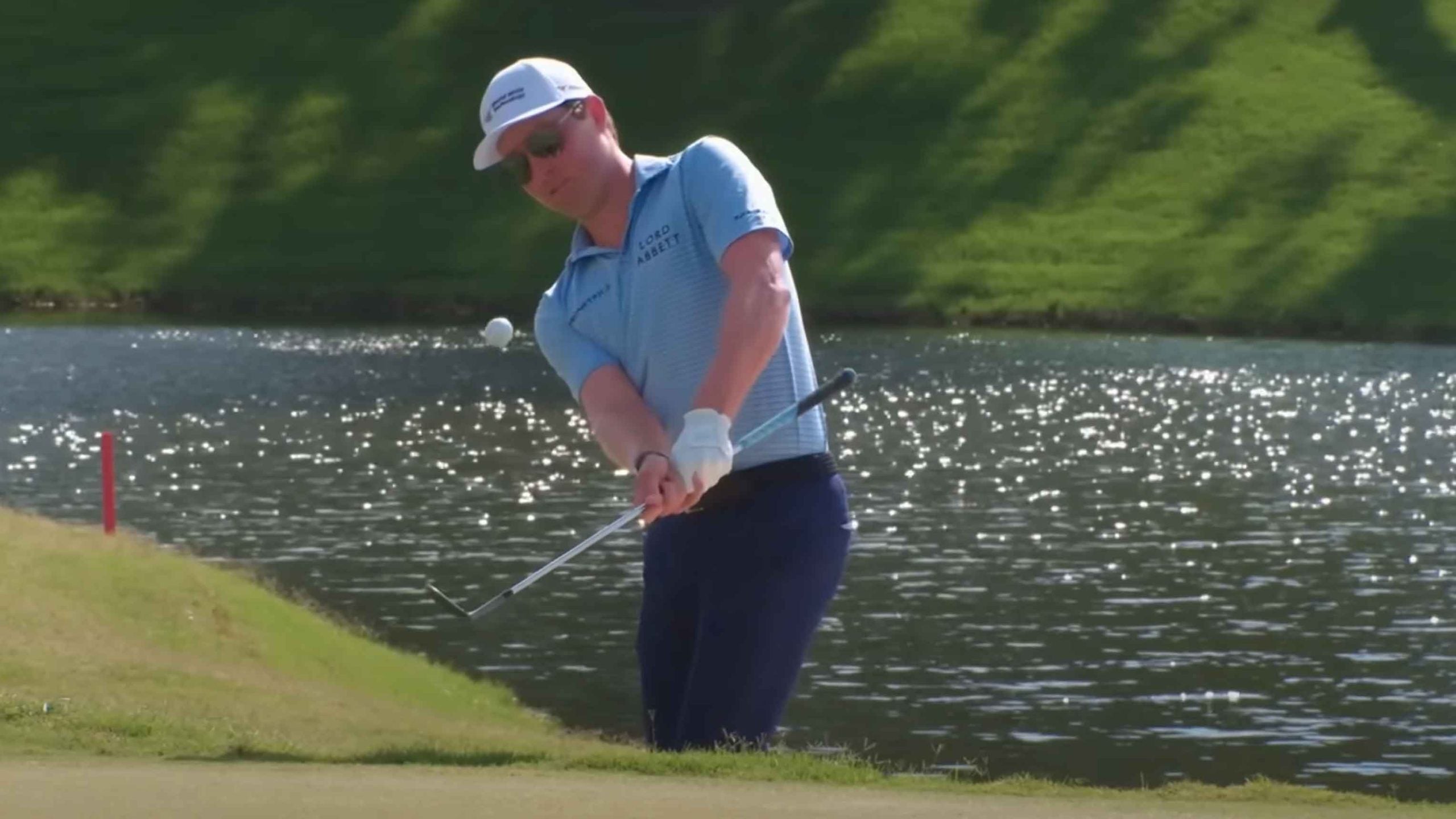
4. Releasing to the target
While still not allowing the face to close, Griffin completed his motion by finishing toward the target. His head and chest continued to turn, and the face of the club remained square. Textbook stuff.