
So you rip a drive down the middle, and you’re probably feeling pretty pleased with yourself. As you should! Nice drive.
Maybe your ball goes past your buddies. Maybe it doesn’t. It’s only natural, at that point, to wonder: How does my driving distance compare to everybody else’s?
On Wednesday, the USGA and R&A released a wide-ranging and detailed look at distance in the game of golf, and specifically, how it’s changed over the years. It’s part of the governing bodies’ years-long investigation into whether technology in golf needs to be reigned-in. In sharing the findings, the duo makes clear that their focus is on “the longest hitters,” and not “impacting hitting distances for shorter hitters at the recreational level.”
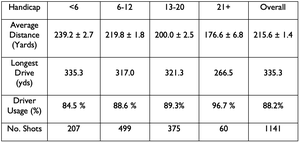
And along the way, the USGA and R&A makes it a point to underline that distance at the recreational level not a cause for concern, which they support with the following graph outlining the average driving distances by handicap, as measured by a sample of club golfers in the U.K. in 2019.
According to the findings:
- Amateur male golfers of all levels average about 215 yards of driving distance.
- Golfers with a handicap between 13 and 20 average 200 yards.
- Golfers between the high single digits and low double digits average just shy of 220 yards.
- Golfers with a handicap below six average just shy of 240 yards.

As for female golfers?
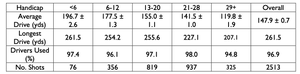
- The average overall driving distance is just shy of 147 yards.
- Female golfers with a handicap between 13 and 20 average 155 yards.
- Those with a handicap between six and 12 average just north of 177 yards.
- The lowest handicap female amateur golfers average just under 200 yards.

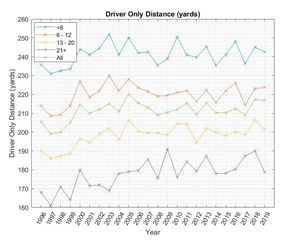
It also went on to show that driving distance in the recreational ranks is one of the clearest correlations with a golfer’s overall handicap. Put simply: You can probably predict how low a player’s handicap is based on how far they hit it.

Some interesting findings that ill hopefully help you figure out where you stack up. And if you’re looking to add some swing speed, you’re in luck, because we’ve got a bunch of good content on the subject right here.