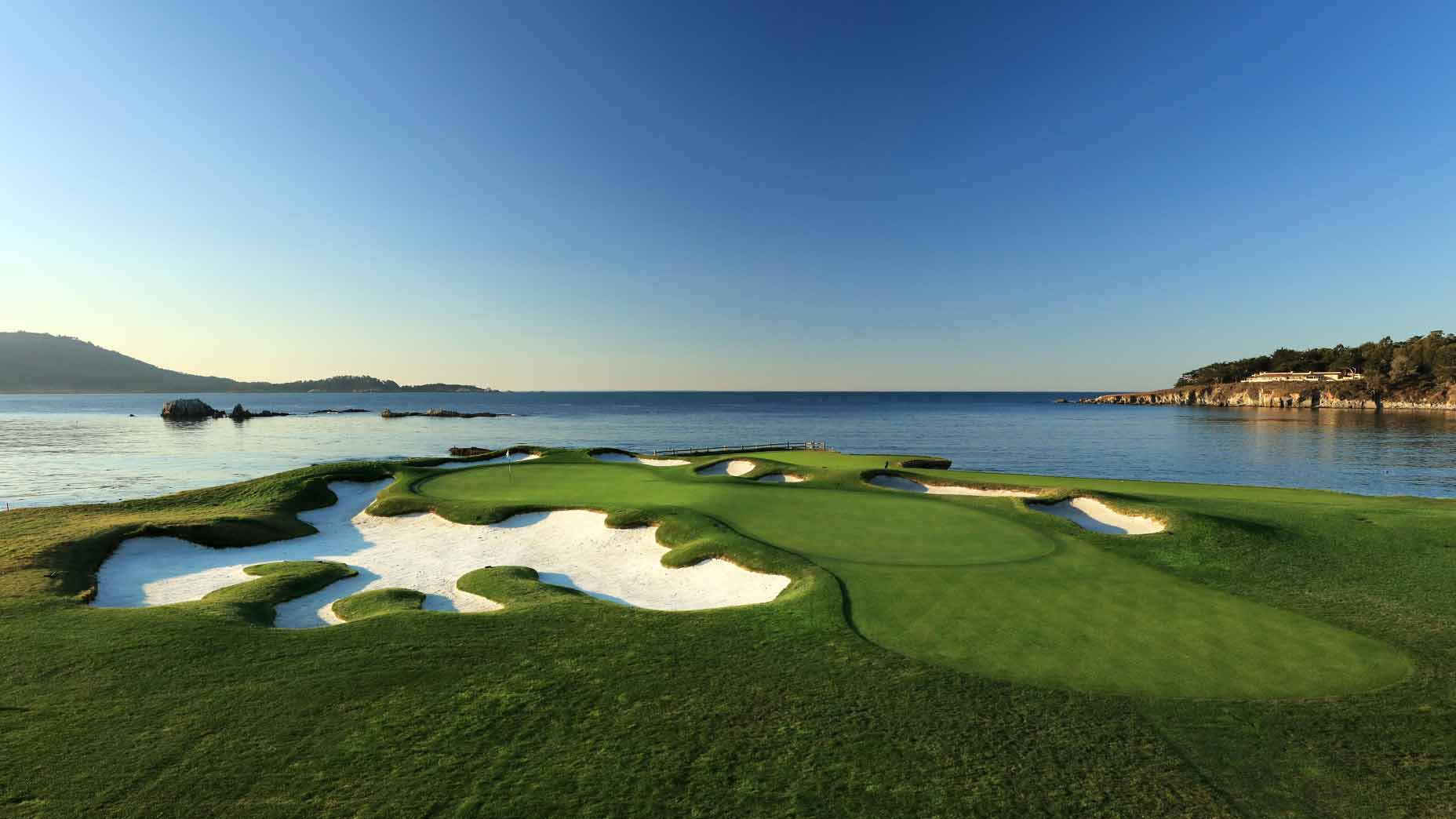
“If Pebble Beach weren’t on the water, would it still be a World Top 100 course?”
On the face of it, that’s a silly question, akin to asking if the Mona Lisa would still be a masterpiece without her smile. The ocean is integral to Pebble, not only in plain view through much of the round but also in play on multiple holes. It’s as inseparable from the design as Lisa’s famously beguiling expression is from Leonardo da Vinci’s work. You can’t discuss one without mentioning the other.
And yet, the Pebble hypothetical is useful as a prompt for a larger question: do courses on the coast get preferred treatment over their inland counterparts?
That topic came up in a recent episode of the Destination Golf podcast, where my co-host Simon Holt and I dug into some of the perceptions — and misperceptions — around GOLF’s World Top 100 rankings. With this year’s list set to publish later this month, we thought it made sense to do some myth-busting: about what influences our panelists, and what doesn’t. We touched on the usual suspects: exclusivity, conditioning, and, yes, seaside scenery.
How much, really, does the coast matter? Simon made the point that a lot depends on context. In the UK or Ireland, where linksland dominates, he said, “if you ranked a parkland course among the top 20 or 30, you’d get laughed out of the room.” By contrast, in the U.S., where the variety of golf geography is pretty much unmatched, many fixtures in the top tier — Augusta National, Merion and Oakmont, among them — are landlocked. If a coastline were the top requirement, Pine Valley wouldn’t be the perennial No. 1.
The deeper you dive into the conversation, the more nuanced it gets. GOLF has no set formula for its rankings. Raters are entrusted to evaluate architecture on its merits — not to be swayed by the non-architectural extras. But a round of golf is an experience, and part of that experience is an exploration of a landscape. The landscape helps lend the course its sense of place. Remove the backdrop from, say, Cabot Cliffs, and the design reads differently. To turn the matter on its head, consider the flip side to coastal splendor: real estate. A water view can elevate a course. A house astride the fairway can deflate it, even if it never comes into play.
In the end, it’s all subjective, and it can be hard to disentangle setting from design. As a parting thought, Simon waxed poetic while pointing to the allure of a coastline. “We’re all human beings. And there’s something about being human beings, we’re drawn to the sea.” Clearly, he’s never spent time among the Dothraki. But I digress. We’re talking golf, not Game of Thrones.
You can hear the full conversation here.