
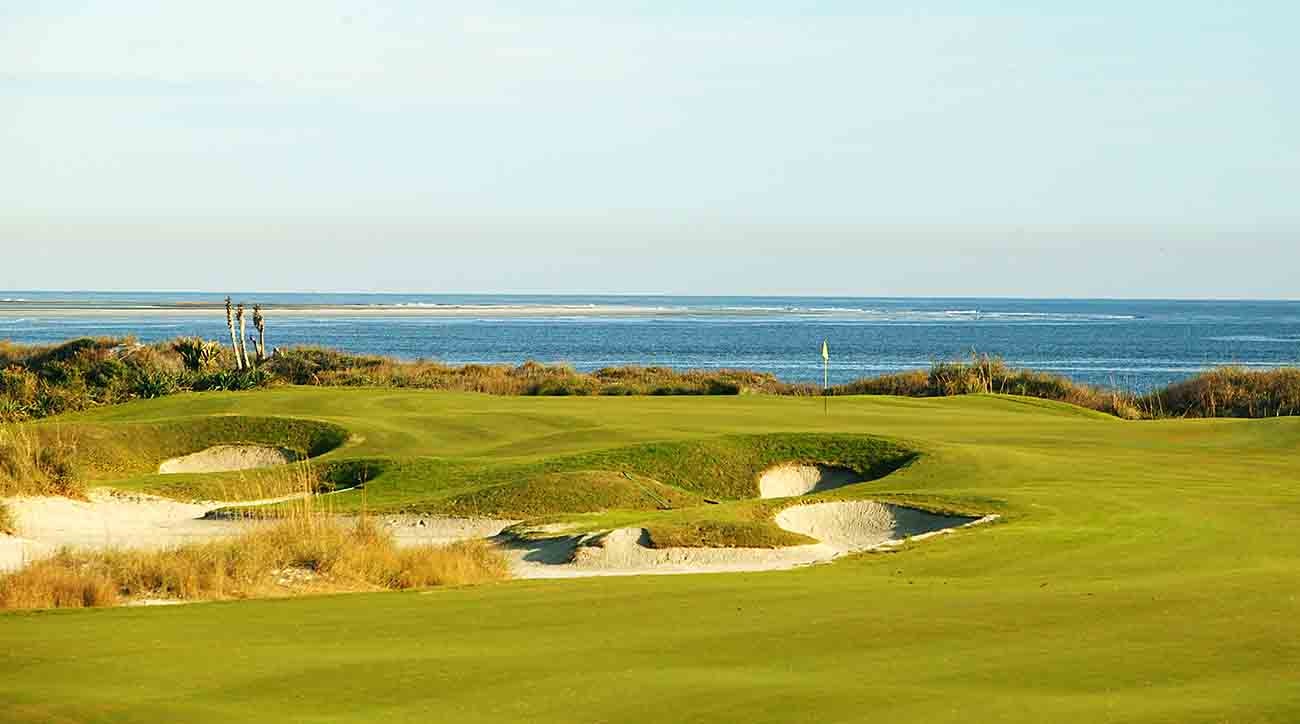
Exquisite torture was a Pete Dye specialty. Not for nothing did the pros call him the “Marquis de Sod.” Among his sadistic markers: a penchant for particularly penal closing holes. Witness the beastly finishers at Whistling Straits, TPC Sawgrass and the Stadium Course at PGA West.
The 18th at the Ocean Course at Kiawah Island belongs in that dastardly canon — a par-4 purpose-built to kick you in the knickers.
The Dyes — Pete and his wife, Alice — designed the Ocean Course for a singular occasion: the course was built from scratch to host the Ryder Cup. It debuted in the fall of 1991, just ahead of matches so contentious they’ve been remembered ever since as the War by the Shore. Drawing on the traditions of Scottish and Irish links, the Ocean Course unfolds along the Atlantic coast of South Carolina, at the mercy of winds that never behave the same way twice. With no prevailing breeze to design around, the Dyes built enough flexibility into the routing to play as two distinct courses depending on the conditions. On any given hole, there can be an eight-club difference from one day to the next.
The 18th is a bear no matter how it’s blowing. The hole stretches nearly 490 yards, it helps to hit it big. But length won’t save you from what Dye was really up to, which was messing with your mind. The fairway is a slender target hemmed in by dunes on both sides, and from the tee it appears far more menacing than it actually is. The prescribed shot traces a gentle left-to-right curve. Miss either way and the sand awaits. The green, nestled in the dunes, is a testy target, too.
When players griped about his punishing finales, Dye had little sympathy. He framed such holes as opportunities — a chance at the kind of lasting fame Ben Hogan achieved with his iconic 1-iron on the 72nd hole of the 1950 U.S. Open at Merion, which earned him a place on the cover of LIFE magazine.
Kiawah’s 18th had other ideas in 1991. Hale Irwin snap-hooked his drive and couldn’t recover. Bernhard Langer, needing just six feet for the win, watched his putt graze the edge and stay out. Two of the era’s finest, undone on the same hole. No glory. No magazine covers. At least not the kind that either player would have wanted framed on his wall.
Related Articles


