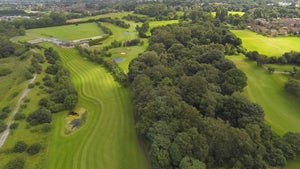
Cramped courses produce cramped minds — and even worse golf swings. Conversely, great joy can be found at an expansive playground like South Florida’s Jupiter Hills Club, with its broad fairways bobbing over surprisingly hilly property five miles north of downtown Jupiter, just west of the Intracoastal Waterway. Its 15th hole, a 429-yarder that curls left around a three-acre lake, epitomizes how a course can feel broad-shouldered yet require precision.
Standing on the tee, a myriad of playing angles present themselves, depending on how far the player can carry the ball. Nothing constrictive here! Yet a few things are in play that aren’t immediately evident. The Atlantic Ocean, for one. It’s one mile to the east and the hole heads toward it, so gauging the wind is imperative before picking your line off the tee. Even on a still day, at some point between when you pull the clubhead back and the beginning of your downswing, the short grass to the right of the lake beckons like a siren.


Here’s the rub: As is the case with Augusta National’s 13th hole, relatively level lies are afforded only on the portion of the fairway to the left, nearest the hazard. The farther right you steer your tee ball — from a hanging lie above the feet of a right-handed golfer — the more awkward your approach shot becomes. Additionally, a live oak, 65 yards short right of the green, complicates the life of those who play timidly away from the lake, not to mention big bombers.
Indeed, caddies at Jupiter Hills wisely recommend hitting 3-wood off the tee. As you can see in the photos, the approach angle from just short of the fairway bunker has great appeal to this front-left-to-back-right-angled green. Given that Jupiter Hills’ greens are among the firmest and fastest in the Southeast, staying below the hole is imperative.
The ideal attack on No. 15? A running draw off the tee followed by a soft fade into the green. Guess who could hit such shots on demand? The course’s architect, George Fazio, who lost to Ben Hogan at Merion in a playoff for the 1950 U.S. Open, some 19 years before construction began at Jupiter Hills. His nephew Tom’s continual enhancements over the years have their vision fully realized.
Need help unriddling the greens at your home course? Pick up a custom Green Book from 8AM Golf affiliate GolfLogix.