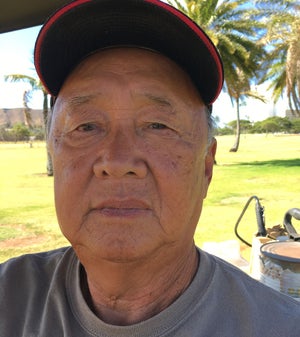
Until recently, Ronald Ching kept a strict routine at his favorite muni: he’d arrive just after daybreak and tee off with five buddies, joining a steady stream of sixsomes with starting times spaced six minutes apart.
Sixsomes at six minutes.
You read that right.
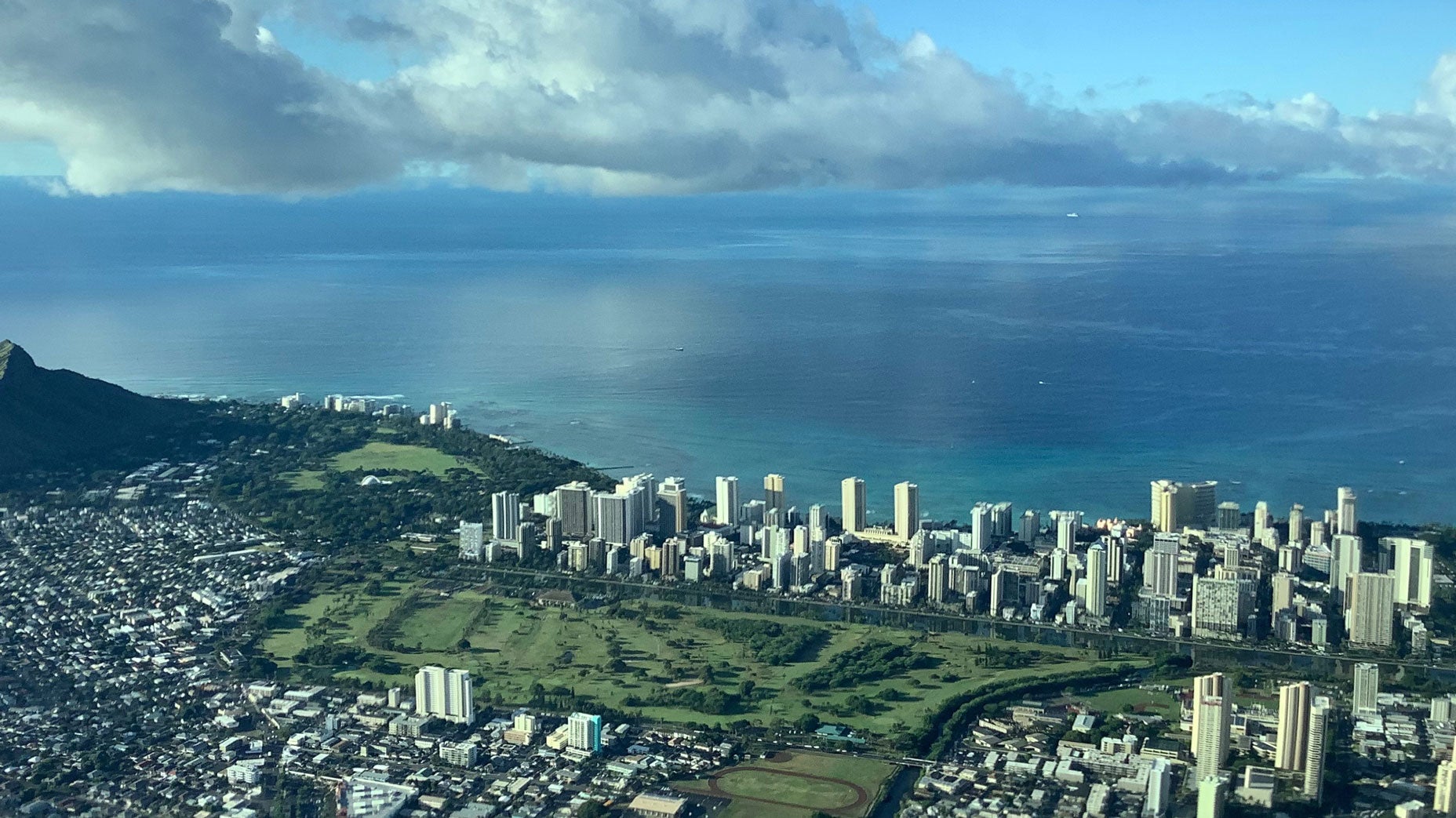
In a world with no shortage of jam-packed munis, Ala Wai has long stood out. Set in the heart of Hawaii’s largest city, a hop-skip from Waikiki Beach, it is far less famous for its design (lush, flat and lined with coconut and monkey pod trees) than it is for its sell-out crowds. Its prime location, coupled with its modest price tag ($22 on weekdays and $26 on weekends for locals) has long made it a public-access magnet, drawing a heavy dose of residents, with a supplemental kick of tourist play.
Ala Wai’s reputation as a mecca reached a frenzied peak the late 1980s, when the National Golf Foundation named it the busiest golf course in the United States. At the time, it was logging close to 200,000 rounds per year, roughly four times as many as the average public track.
While play at Ala Wai has ebbed and flowed in the decades since, mostly it has flowed. And the course has never not been busy. On any given day, if you showed up as a single, you might spend as much time on the waitlist as you took to play your round, which, unsurprisingly, was rarely brisk.
Not that management didn’t try to keep things moving. As a pace-improvement measure, it was not unheard of for the starter at Ala Wai to ask two golfers in the same group to tee off simultaneously on the first hole.
Synchronized driving.
You read that right, too.
Given the congestion, Ronald Ching has always made a point of phoning the automatic reservation system the instant bookings are released: at 6:30 a.m, one week in advance.
“If you call at 6:31,” he says, “you might be out of luck.”
Nowadays, though, when he places his early morning call, Ching is no longer booking for a sixsome.
Since early May, when Hawaii courses reopened after a nearly two-month shutdown, the state has limited golf groups to foursomes, max. Along with that new rule, tee time intervals at Ala Wai have been doubled to 12 minutes (those intervals are expected to decrease to 9 minutes in the coming weeks), and waitlists have been done away with altogether. For health and safety reasons, no one wants a bunch of golfers hanging out and hoping for a chance to play.
By industry standards, Ala Wai remains a thrumming operation, but it’s only half as busy as its former self. Volume is down 50 percent.
One day last week, Ching and three pals teed off at 7 a.m., and, he says, “by 9:30, we were on 18.”
While the breezier pace of play is not a bad thing in itself, Ala Wai’s new normal has broader implications. The island of Oahu is home to six munis, and Ala Wai, the biggest moneymaker of them, helps subsidize the others. When its revenue dwindles, ripple effects are felt downstream.

Compounding that problem for Oahu’s munis is the loss of another vital source of income. Tourism in Hawaii has dropped to next to nothing, which means that no one’s paying out-of-town greens fees—-a higher rate that helps keep the price for locals down.
It doesn’t take a gloom-and-doomer to see potential dark clouds on the horizon.
“I’ve always been an optimist but I’m worried,” says NBC golf broadcaster and longtime Hawaii resident Mark Rolfing, a longtime advocate of municipal golf in the state. “The money from local play is not enough to sustain municipal courses in Hawaii in the long term. We need additional revenue streams, and the current crisis has cut those off.”
Three years ago, to help bolster muni golf on Oahu, Rolfing helped negotiate a deal to build a Topgolf on the driving range at Ala Wai; under the plan, some proceeds from the facility were earmarked for the island’s munis. But construction on that Topgolf has been suspended temporarily, as it has for all of the company’s projects in development, a Topgolf spokesperson told GOLF.com.
There is no word yet as to when it might resume.
As with so many things in so many places, questions loom over the future of munis on Oahu.
But for Ronald Ching, for now, those are questions for another day.
Living in the moment. That’s what he prefers, especially the moments he spends at Ala Wai, where he doesn’t merely play. For the past 21 years, since retiring from his job in the airline industry, he has also volunteered on Ala Wai’s maintenance crew. He pegs it with his buddies three days a week, then pulls weeds and fixes pitch marks the other four.
In recent weeks, Ching says, he’s been enjoying the relatively quick rhythms of his rounds. But he never found the big crowds an incumbrance, either. Sixsomes. Foursomes. Fast play. Slow play. Hitting drives or repairing divots.
He’s just happy to be out there.
“Any day above ground is a good day,” he says. “And if you’re on the golf course, better still.”
This is part of our Muni Monday series, spotlighting stories from the world of city- and county-owned golf courses around the world. Got a muni story that needs telling? Send tips to Dylan Dethier or to munimondays@gmail.com and follow Muni Mondays on Instagram.