
ARDMORE, Pa. — From the first time I set foot at Merion, about 40 years ago, I found myself drawn to the club’s caddies and their stories. My first host at Merion — for lunch in the men’s grill, as it was called then — was a former Merion caddie who became a member, a good local amateur and a prominent lawyer in town. He might have been the first to make the climb from the dank subterranean pen where the caddies used to wait for their loops to the men’s locker room, on the second-floor of the clubhouse, with its shower heads the size of small pizzas. The Merion caddie crew noted this ascension. Later, another Merion caddie, Mike Mayock, the son of a local high school football coach, became a member, an NFL executive and a broadcaster. The Merion caddie crew noted this ascension. The Merion caddie crew is a thing unto itself.
This week, at the U.S. Amateur at Merion, there were 312 players vying for 64 spots in the match-play portion of the event. Forty-nine players took Merion caddies. Said another way, nearly every fulltime summer caddie at Merion, 10 of them college kids, landed a bag in the Am. It’s hard to imagine a more powerful statement about the quality of this eclectic caddie crew.
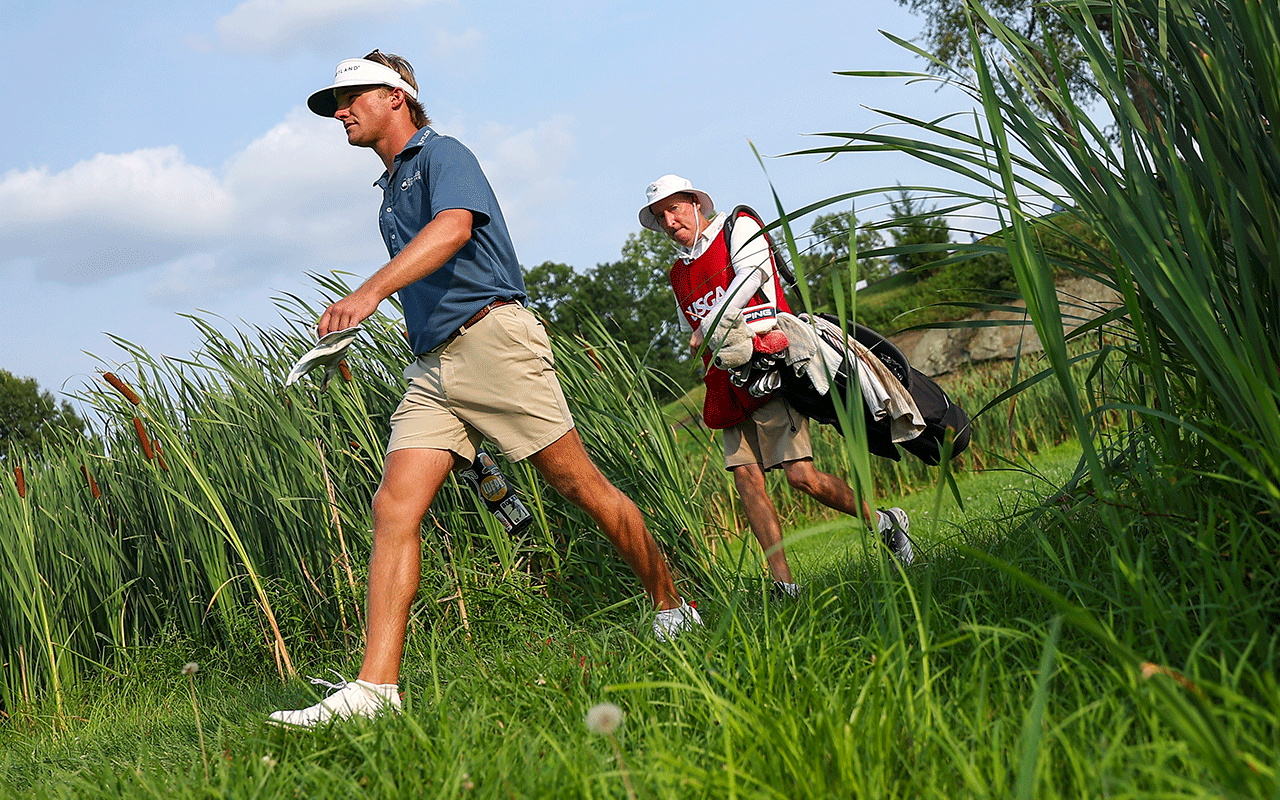
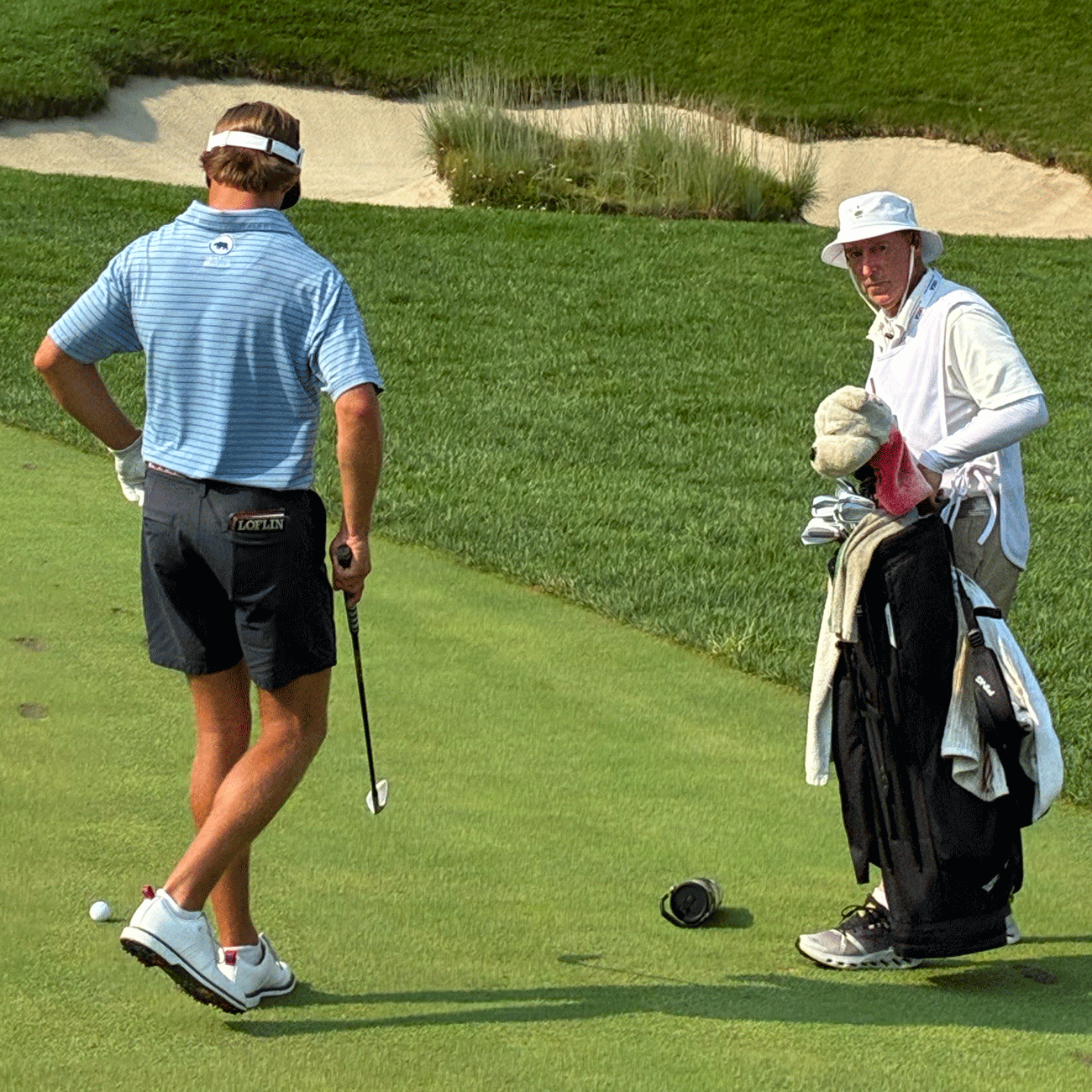
As of Saturday’s semifinals, one Merion caddie was left, Jack Hopkins in his white floppy hat and white sun sleeves, caddying for Carter Loflin, the University of Georgia golfer. There were Merion caddies on the course, current and former, following . . . Hopkins, a mild-mannered gent and the dean of the Merion caddies. In his comments to reporters, Loflin heaped praise on his man.
Hopkins is quiet and direct — an old-school caddie. When I asked him the difference between reading the greens for a player trying to break 95 and for Loflin, this is what he said:
“You give them the same read, but you’re more nervous, reading them for Carter. Because he’s actually going to roll it where you tell him to.”
Perfect.
There’s a train stop almost at Merion’s front door — the Ardmore stop on SEPTA’s Paoli-Thorndale Line. The members don’t come by train, but Merion caddies have for decades. Not like they used to, but they still do. Merion has always drawn caddies from Black neighborhoods in West Philadelphia, in the vicinity of the city-owned Cobbs Creek course, which, like Merion, was designed by Hugh Wilson. There are also middle-class and working-class suburban neighborhoods near the course where a lot of kids, often from large Catholic families, were drawn to Merion and the cash money you could make there.
I had a friend named Fred Anton who caddied at Merion all through his four years at Haverford High and his seven years at Villanova, for college and law school. He caddied in the 1950 U.S. Open at Merion as a 16-year-old, and it changed the course of his life. He won the club’s caddie championship as a teenager but gave himself a putt after missing it and lived with that guilt for the rest of his life. The man who put him up for membership at Merion was also the person who blackballed his application, the guy who buried it. Merion’s an interesting place. Merion the course is a fascination and a puzzle, and you could say the same of its people, at least some of them.
Jack Hopkins is a neighborhood caddie. He started caddying at Merion in the 1970s as a 12-year-old and caddied at the club all through his years at Archbishop Carroll High School. (Two other local Catholic schools, Bishop McDevitt and Monsignor Bonner, have turned out their share of Merion caddies, too.) Hopkins is one of the few caddies left who remember the basement caddie shack. It was converted into a cart barn decades ago and nobody shed a tear. Not that its standalone replacement, hidden in a discreet hollow near the clubhouse and beyond the 13th green, is a Taj Mahal, because it’s not. There’s a footpath straight there from the train station. It has a fridge and a restroom and a flatscreen TV, the Eagles on it all through the fall. The caddies often have action on some kind of sporting event, or anything, really.
There was more of that in the era when Hopkins was starting out. There was more tension then, between (you might say) the city caddies and the suburban caddies. The highlight of the schoolboy basketball year is when the winner of the city’s Public League plays the winner of the Philadelphia Catholic League. Philadelphia is a basketball town, a hockey town, a football town, a baseball town and a golf town.
There used to be plaques in the old men’s grill at Merion that listed the winners of the club’s Hugh Wilson Invitational. Talk about getting paint. Brad Faxon’s name was up there, the winner in 1980. The next year, the U.S. Open was at Merion, and Faxon, still an amateur, drew good support in the caddies’ DFL pool. Well, he proved them wrong. Yes, he shot 70-82 and missed the cut by a bunch. But the DFL winner went for 82 and 86.
By the time I started coming around, arcana from that ’81 Open was still alive and well, among the members and especially among the caddies. Caddies are funny that way. When the men’s grill went co-ed and those Hugh Wilson plaques went to the men’s locker room. They used to say at Merion that the greens had air conditioning and that the locker room did not. I don’t know who came up with that line but I’m guessing it was a caddie. I’ll ask Jack Hopkins, when this week is over.
Jack knows everything at Merion, just about. I was able to tell him one thing he did not know the other day. For part of one day, I knew Howard Rexford, the teenager who caddied for Bobby Jones when Jones completed the Grand Slam by winning the 1930 U.S. Amateur at Merion. (I wrote him up for the Philadelphia Inquirer in the late 1980s.) That week shaped the rest of Rexford’s life.
“You know how much Jones paid him?” I asked Jack.
Jack shook his head. He doesn’t waste words. Loflin, who is voluble, likes that about him.

“One-hundred and fifty dollars, in the Depression.” Fifteen $10 bills.
Jack half-whistled. But his payday is the least of his concerns this week. He’s not working for bragging rights, either. He’s not built for that. He’s doing a job for his guy, and if he becomes a footnote in the game’s lore along the way, that’s just a bonus.
Jack has caddied innumerable times for Liz Haines, one of Merion’s best players over the years. Liz’s husband, the late George Haines, used to write the quiz in the back of Golf Journal, the USGA publication. George told Liz, and Liz told Jack, and Jack keeps it under his bucket hat — all he knows about the game and about Merion — unless there’s an argument to be settled, something like that. He knows the members, and the members know him. That’s not uncommon at Merion.
There’s a Merion member who is a dentist who offers free dental work to the Merion caddies. Many Merion members help caddies find more reliable work. There was a Merion member who got my buddy Gerry Gallagher into the mortgage-selling business. Gerry was a Scotsman with a beautiful baritone brogue and a backswing out of the Ernie Els school. Just a lovely, wonderful man who died far too young, a victim of his addiction to alcohol. Members were heartbroken, and of course the caddies were, too.
There have been Merion caddies in and out of rehab and in and out of hospitals who have been helped by members over the years. Caddies far from home who needed help to get there for family emergencies. Caddies who needed tuition help. During one of the early days of this year’s Am, Merion’s longtime pro, Scott Nye, was driving the father of a Merion caddie around the course, so the man could see his son in action despite health issues that made walking the course impossible.
You could say that caddies know their place at Merion. They’re not showmen. They’re caddies. But there’s also an unusual bond there, between caddie and player. Carter Loflin has already picked up on that. On Friday afternoon he closed out his match on the 16th green. In the aftermath, Hopkins talked briefly to some well-wishers, caddies and former caddies among them.
“You go ahead,” Hopkins said to his player.
“No, no, I’m waiting,” Loflin said. “I want to walk in with you.”
Michael Bamberger welcomes your comments at Michael.Bamberger@Golf.com.


