In order to gain a full and complete appreciation of the Masters and its “tradition unlike any other,” it’s important to understand that the tournament has its own vernacular, which can be confusing to first-time viewers.
But even if you’re a seasoned Augusta aficionado, it never hurts to brush up on your Masters vocabulary. Check out this alphabetized list of the 19 words you simply must know to possess a thorough knowledge of all things ANGC.
Amen Corner: The area of the course that encompasses holes 11, 12 and 13. Back in 1958, Herbert Warren Wind used the description in an issue of Sports Illustrated. The par-3 12th is also Augusta’s signature hole, with the green framed by blooming azaleas in the spring.
Azalea: A flowering shrub that is absolutely everywhere at Augusta National. It’s also the name of the 13th hole.
Berckman’s Place: An exclusive, 90,000 square-foot entertainment pavilion for ANGC MVPs. There are five full-service restaurants, a pro shop and replica putting greens to play on.
Butler Cabin: One of many “cabins,” built on the property, Butler Cabin is most notable because it’s where the winner’s interview takes place every year, and where the winner gets to don his green jacket for the first time.
Eisenhower Tree: Augusta National’s most famous loblolly pine. The Eisenhower tree was located off the 17th fairway and was so named because former U.S. President and Augusta National member Dwight D. Eisenhower lobbied to have the tree removed because he reportedly hit into it. In 2014, an ice storm damaged the tree to such an extent that it was removed.

First and second nine: Augusta’s synonym for the front and the back sides of the golf course.
First cut: The rough — the “first cut” of longer grass separating it from the shorter grass of the fairway.
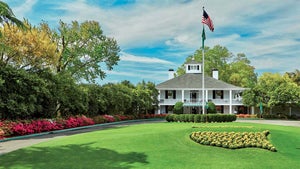
Founder’s Circle: An area in front of the Augusta National clubhouse that is a popular spot for photos because of the picturesque setting, complete with plaques and an Augusta National logo made of flowers.
Green jacket: A formal green blazer emblazoned with the Augusta National logo and donned by every Augusta National member during tournament week. A green jacket is given to every winner of the Masters. Sam Snead was the recipient of the first green jacket in 1949.
Hogan Bridge: A stone bridge that take players over Rae’s Creek to Augusta National’s 12th green. The bridge was named for Ben Hogan 1958 to commemorate Hogan’s four-round total score of 274 (70, 69, 66, 69) in 1953, which eclipsed the previous scoring record by five shots.
Ike’s Pond: A three-acre, spring-fed pond located on Augusta National’s Par-3 course that was built when President Dwight D. Eisenhower suggested it would be a good place for a fish pond.
Loblolly pine: A large, evergreen tree that is everywhere at Augusta National.
Magnolia Lane: An iconic, 330-yard driveway that is lined on each side by magnolia trees and leads to the Augusta National clubhouse.

Nelson Bridge: The bridge from the 13th tee to the fairway that was named for Byron Nelson in 1958 for his scores of 2 and 3 on Nos. 12 and 13, which propelled him to victory in the 1937 Masters.
Patron: Fan, spectator. Augusta’s use of the word dates back to a preference of Clifford Roberts, a co-founder of the Masters and Augusta National.
Pimento cheese: A mix of cheddar cheese, mayonnaise and pimentos (mild peppers with a sweet flavor) that, when spread on a slice of white bread, becomes the Masters’ signature sandwich.
Pine straw: Pine needles, many of which line the areas of the course beyond the first cut.
Rae’s Creek: A body of water that winds behind the 11th green and in front of the 12th green, thereby adding intrigue to some of Augusta National’s most famous and consequential holes.
Sarazen Bridge: The first bridge ever dedicated to a player at Augusta National, the Sarazen Bridge was named for Gene Sarazen in 1955 to commemorate his holed 4-wood from 235 yards on No. 15 in 1935, which propelled him into a playoff, which he won.


