If you’re like a lot of golfers, you don’t hit all your greens in regulation.
Your maintenance stats are probably spotty, too.
Odds are you don’t always repair your pitch marks on the putting surface.
And even when you do, there’s a chance you go about it in the wrong way.
Mark Patterson, a longtime member of the Golf Course Superintendents Association of America, is the top man in turf care at Legacy Golf Club at Lakewood Ranch and Serenoa Golf Club, both in Florida.
The way he and many superintendents see it, any effort is better than no effort.
“If a golfer is going to attempt to repair a pitch mark, I deeply appreciate that,” Patterson says. “And if they’re using the wrong technique, that’s just a sign that we need to do a better job of educating them.”
In the spirit, here’s an overview of Patterson’s pitch mark do’s and don’ts, along with a supplemental video tutorial (above), starring Patterson himself.
Tool of the trade
It’s called a divot-repair tool for a reason. Those pronged things are designed to fix pitch marks, and they make the job easier. Bu they’re not the only implement you can use. A tee, Patterson says, fits the bill just fine. Same with a pencil or a car key. If you happen to be carrying a fork or a chopstick, feel free to employ those, too.
“What matters most isn’t what you use but your technique,” Patterson says.


The proper approach
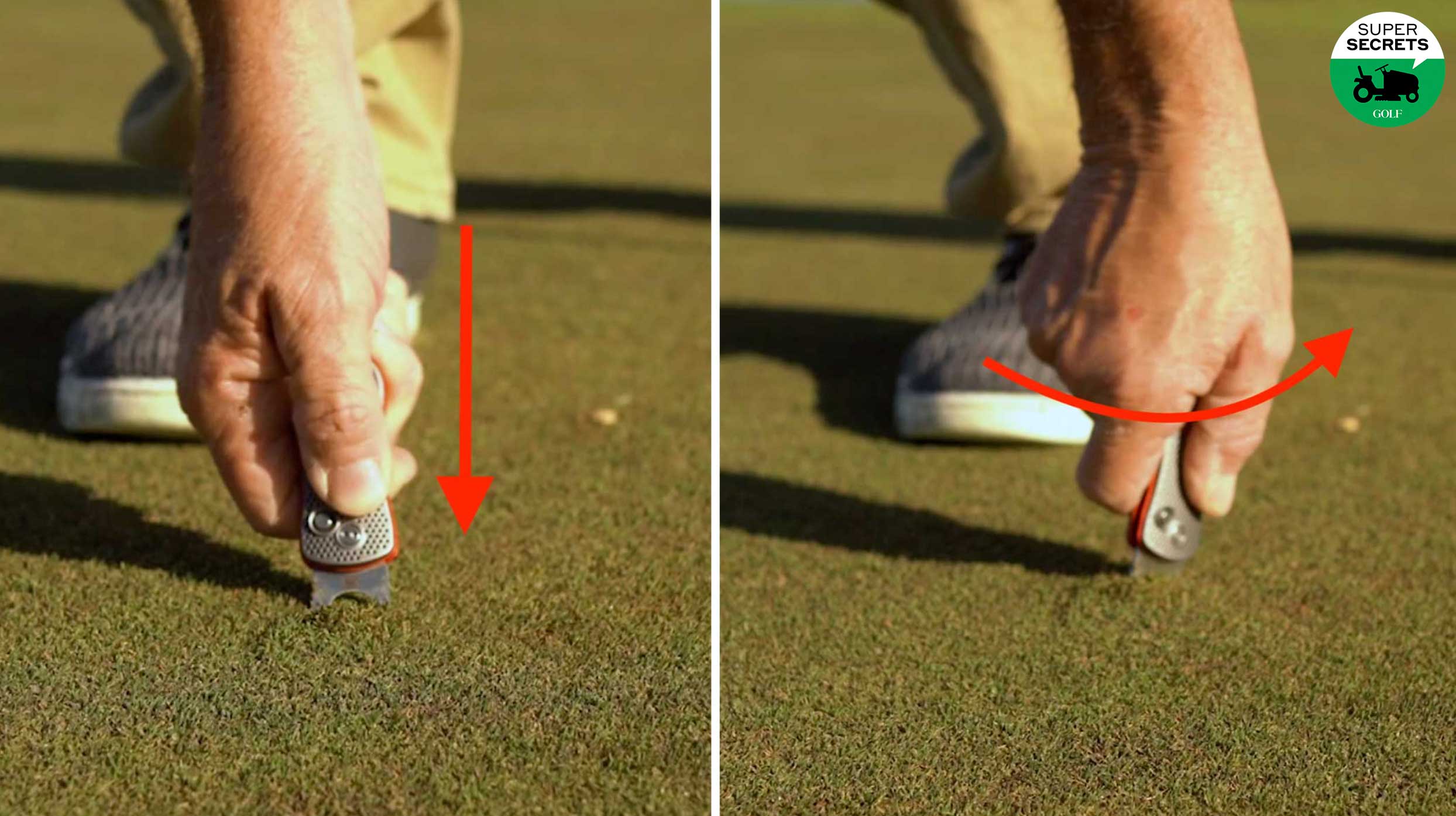
Resist the urge to dig your tool into the turf and pull straight up. That’s a common tendency, repeated all too often by Tour pros on TV, and it’s counterproductive, as it tears the grass roots, which can kill the turf.
The right technique is to work around the pitch mark, starting on the high side, where the turf has been pushed up higher by the angle of the shot, and move in a circle around the depression, pulling the surrounding turf toward the center until that mini-crater is filled. Think of it at a “twist-and-up” motion. When you’re finished, tamp down gently on the turf with your putter to smooth over any lingering tufts.
Repair more than one
The golden rule of golf course maintenance is to always leave the grounds in better condition than you found them. By definition, that means you need to do more than repair your own pitch mark. This isn’t hard. While your playing partners are plum-bobbing or otherwise wasting time, fix another pitch. And then maybe a third.