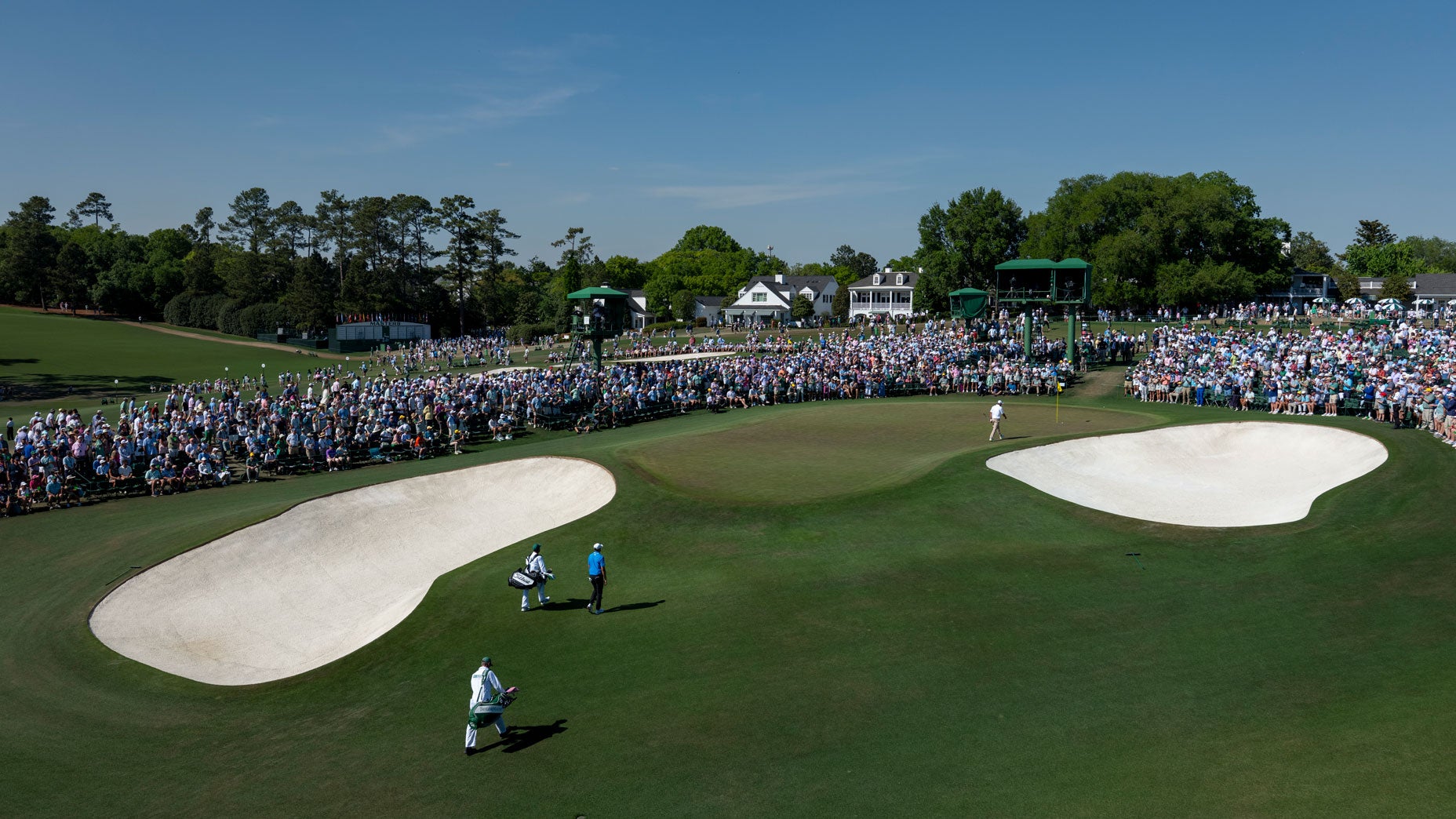
The Masters isn’t life or death. Not for golfers.
But it is for grass.
To produce the conditions the tournament is famed for — firm, smooth, lightning-fast — Augusta National’s maintenance team pushes turf to the limits of survival, letting it go thirsty, cutting it as short as five o’clock stubble.
Haotong Li described the effects vividly.
“Greens were definitely baked out,” Li said after a third-round 69 that left him in a tie for seventh. “It’s just so firm and green runs so quick. The grass are almost died actually.”
Almost. And that’s the point. It’s all part of a risk-reward game that turns the course into a premium playing surface while placing the grass under enormous strain.
The results can be visible to fans, too. Though the Masters is practically synonymous with green, it’s not uncommon for faint hints of brown to appear around the course as the tournament progresses, particularly when the weather is dry and breezy, as it has been this week. Television can exaggerate those discolorations. Still, as one veteran superintendent told Golf.com, those hints of brown have shown up earlier than usual in 2026.
As with most club matters, Augusta National does not comment publicly on its maintenance practices. But another superintendent with experience in Masters preparations said that brown can result from many factors, and that color alone is not a sign of a conditioning problem.
“At a place like Augusta, soft is unacceptable and slow is unacceptable,” the superintendent said. “If you want elite performance, you’ve got to get right to the edge of agronomic failure without crossing it.”
To do that, he said, “you back off irrigation hard, use heavy rolling, and possibly regulate growth aggressively.”
At Augusta National, he added, everything “is by design.” If the course looks a shade browner in places this year, it doesn’t mean anyone has dropped the ball. But it might reflect a shift in maintenance philosophy since the departure of Brad Owen, the club’s longtime director of agronomy, two years ago. Even the smallest change in any number of practices — fertilizer applications, mowing and rolling patterns, more continuous use of SubAir, the underground system that regulates moisture in the greens — could have a subtle influence on aesthetics. Throw in factors beyond even Augusta National’s control, like high winds or sudden spikes in evapotranspiration, and some variation is inevitable.
It’s unrealistic to expect a golf course to never change. What is realistic is to expect elite playing surfaces. On that front, no one has complained. Per usual, the course has earned nothing but praise from players, including Jason Day, who hailed the course conditions as impeccable after his Saturday round.
As today’s final round gets underway, Day is part of a packed leaderboard. Every golfer in the mix will experience the pressure. But they won’t be alone in feeling the strain.