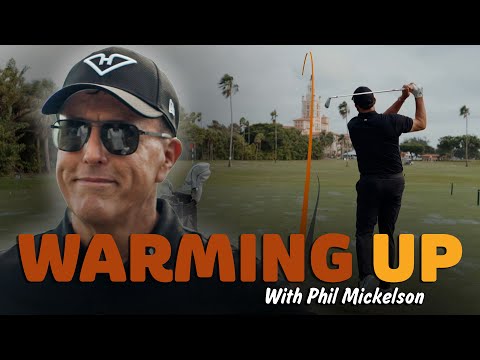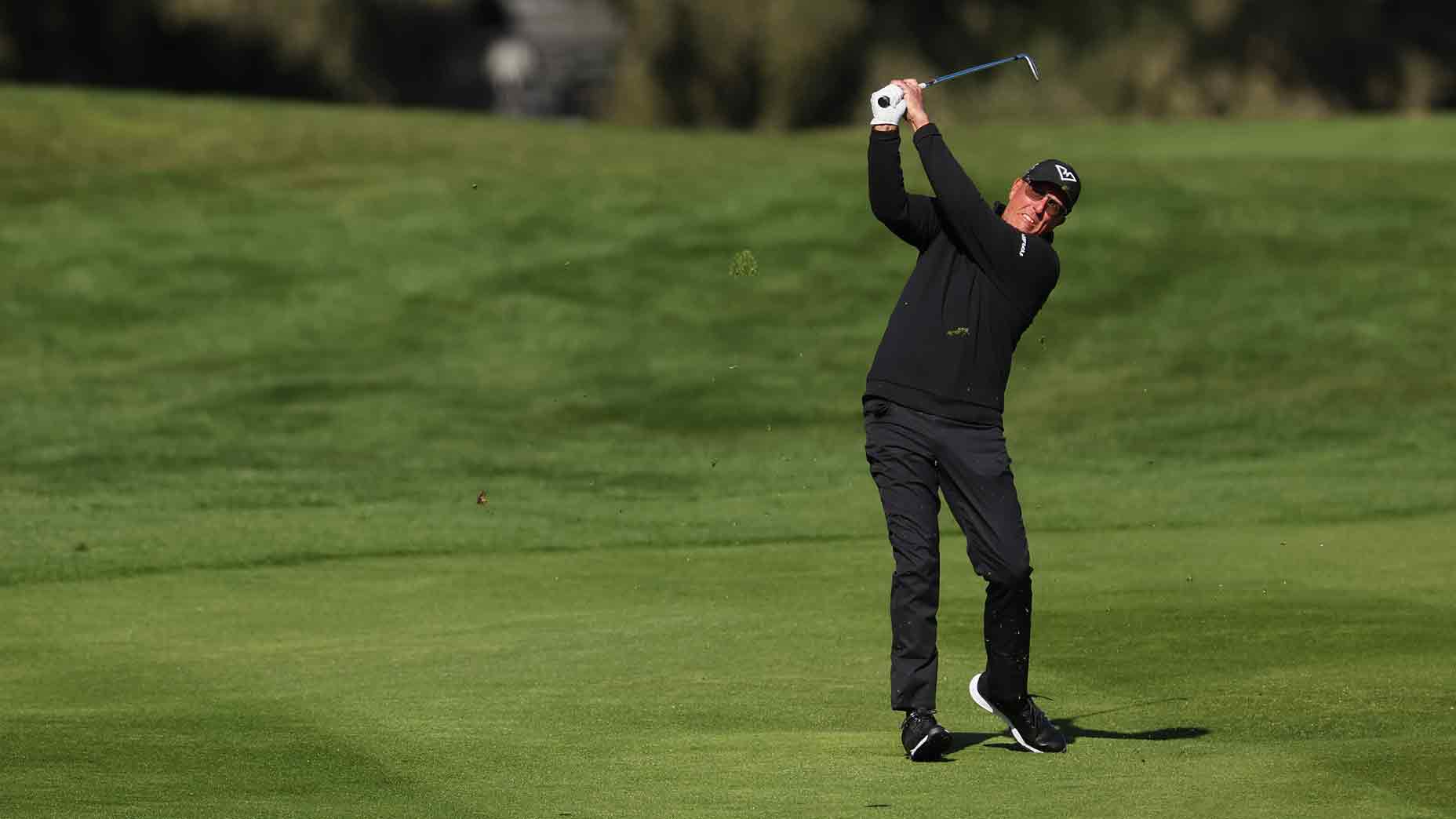
When it comes to warming up, Phil Mickelson has plenty of boxes he needs to check until he’s ready to make his way to the first tee.
One of the most important is his ability to feel himself making good contact. This means working on his swing mechanics and dialing in his fundamentals, which helps him give himself the best opportunity for a great ball-striking day.
If this isn’t dialed in while on the range, there’s a good chance it won’t be there when Mickelson needs it the most during a round.


The six-time major champ recently talked to our Dylan Dethier about a number of topics on GOLF’s Warming Up. One of those things was the difference between a poor ball-striker and a good ball-striker — with Mickelson giving his two cents.
Take a look below to see what Mickelson says any player struggling to make good contact must correct first.
Phil Mickelson says this is the key to better ball-striking
Mickelson grabs a pitching wedge from his bag and presents an imaginary situation that he’s experienced more than a few times in his career.
“[Let’s pretend] I’m on hole 14 at Augusta, and I just hit a nice drive, with the pin over there on the right,” he says. “I want to hit it really high and get it to stop as quick as I can.
“I’m going to get my alignment, and I’m not going to draw this one (so it’ll be straight), but the wind’s going to push it and it’ll go high, so I’m going to cast this club a little bit.”
Dethier then asks Mickelson what the difference is between hitting a straight ball compared to a draw or a fade.
“It’s a feel thing,” Mickelson says. “If I’m hitting a draw, I’ll let [my arm] release over. If I’m hitting a fade, I’ll get a little wider and try to hit the outside part of the ball; which slows down the release of the club.
“[When hitting a straight shot], I’m just feeling the club go back to square.”
This, Mickelson adds, is where you can differentiate the good from the bad ball-strikers.
“You won’t find a good ball-striker who doesn’t setup with a straight line arm and club. You can return to that position (even swinging 100 miles per hour, or whatever), and feel yourself going back to square,” he says.
“If you start with your lead arm bent, there’s looseness. If you start there, you can’t go back to a certain point in the backswing, stop, and go forward. But if you start in a straight line, you can take it back and you’re in a position to go forward.”
With added focus on the positioning of your hands, you can improve your ball-striking.
“If you start with your hands back, you go to any point, you have to wait for the club to down,” he adds. “All [poor] ball-strikers will start with their hands back, while all good ones will start with their lead arm straight. So I’ll start with a straight line going back, and then I’ll feel it cast back to a straight line [coming down].”
You can watch the full Warming Up episode with Phil Mickelson below, and get other great golf tips by following GOLF’s YouTube channel.