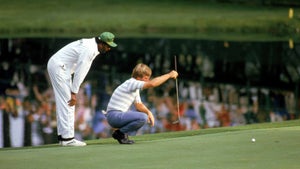
I think that as golfers we can all agree that one of the most annoying things that can happen during a round of golf is 3-putting. Whether it be because we put ourselves in a bad spot on the green away from the flag, or we just get too aggressive or tentative on the first attempt, there is no good way to take three strokes on the green.
But can there be such a thing as a reasonable 3-putt? And how many times should we expect to 3-putt based on our handicap, and how does that compare to professionals at the highest level?
Let’s find out.
The pros


When looking at data from the PGA Tour, the tour average tells us that a player will 3-putt 2.73% of the time, so for every 1000 holes played, they are likely to 3-putt just over 27 times. Another way to put it is that the average PGA tour player will 3-putt once every two rounds of golf.
Considering how many players there are on the PGA Tour, it’s amazing to see that Maverick McNealy is the only player to have a 3-putt percentage under 1%, meaning that he has to play just under 108 holes, or seven rounds of golf, before he is likely to 3-putt (pretty insane numbers)!
Now, if you’re wondering how your game should stack up on the greens — and if you’re doing better than most or need to really work on your putting — we have data from Arccos Golf on how often you are likely to 3-putt based on your handicap.
3-Putts based on handicap

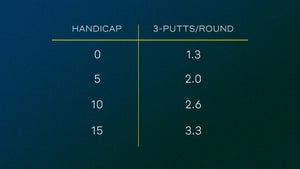
Data collected from Arccos Golf users show us that even the average scratch golfer is likely to 3-putt at least once every round of golf, and as you might imagine, as handicaps go up so do the number of 3-putts per round.


This falls in line with a lot of other handicap related data that shows the best way to lowering your scores is to worry less about making birdies and more about reducing big numbers on your scorecard. Similar to 3-putts, the same can be said for the club on the other end of your golf bag with the driver, because shots lost off the tee by penalty strokes result in a huge disadvantage when approaching greens and, from there, trying to save shots when you’re already feeling like you have to catch up can result in compounding mistakes.
Average birdies per round:
— Lou Stagner (Golf Stat Pro) (@LouStagner) August 25, 2021
Scratch players:
▶️2.2
20-handicap players:
▶️0.3
Scratch players make 1.9 more birdies per round.
For amateurs, the biggest component to better golf is NOT more birdies, it’s less bogeys, less doubles, and less others.
So next time you’re on the course and happen to 3-putt, remember that based on your handicap — even if you’re a scratch golfer — there is a very high likelihood that it’s going to happen a couple of times a round, so as long as you can keep it below your expected average there is a good chance you’re going to score better at the end of the day.
Looking to overhaul your gear? Head to an industry-leading True Spec Golf fitting studio near you, and for more on the latest gear news and information, check out the Fully Equipped podcast.
Related Articles