

Welcome to Shaving Strokes, a new GOLF.com series in which we’re sharing improvements, learnings and takeaways from amateur golfers just like you — including some of the speed bumps and challenges they faced along the way.
Like any golfer, I love to dive into data and performance analytics to help better understand my game.
While it’s fun to see what my launch angle is when using a 6-iron or what my carry distance looks like with my driver, it doesn’t really matter if my scores continue to balloon during a round. After all, the whole point of golf is to get the ball in the hole in as few strokes as possible.
That’s why I find the information below to be really interesting.
Using data from Lou Stagner and Arccos (you can subscribe to Stagner’s excellent newsletter here), we’re able to get a sense of how a player performs depending on a golf hole’s handicap — from scratch golfers all the way up to players carrying a 20 index.
Take a look below to see how more difficult holes may impact your scores.
Performance by golf hole handicap
Have you ever stood on the tee box of the hardest handicap hole and thought, Man, this is going to be a beast to tackle.’ Most likely, especially if it’s long par-4 or par-5 and has things like water, out of bounds, a tricky green and tucked pin position.
But does the hardest hole actually live up to its billing? That’s where the data from Stagner and Arccos comes in handy, as the image below illustrates some answers.

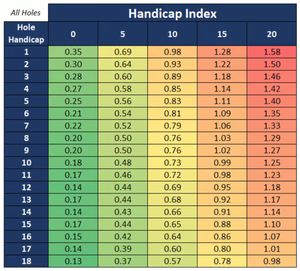
According to the data, the hardest handicap holes typically play the most difficult, regardless of a player’s ability.
For example, scratch players average 0.35 strokes over par on the No. 1 handicap hole — or the hardest hole on the scorecard.
Unsurprisingly, scores increase as handicaps get higher, with a 20-handicap player averaging 1.58 strokes over par on the hardest-ranked hole.
Another thing I found interesting is how a scratch golfer can maintain a certain level of consistency despite a hole’s handicap. As the table shows, this top-level player averages 0.18 strokes over par on the 10th-hardest hole, but 0.17 on the 15th-hardest hole. Sure, it fluctuates a bit in-between, but, generally speaking, it means they have a game plan for each shot, stick to it, and then go out and execute it.
Meanwhile, a 20 handicapper averages a difference of 0.27 strokes between the 10th-hardest hole and the easiest hole. That’s a pretty wide gap when we’re talking about either gaining or losing a stroke. Narrow that, and players looking to break 100 may find themselves breaking 90 more regularly.
So use this information to your advantage — especially if you’re a mid- to high-handicapper. By understanding what the average score over par is on each handicapped hole, you can make the necessary adjustments to try and play better golf.


