Welcome to Play Smart, a game-improvement column that drops every Monday, Wednesday and Friday from Game Improvement Editor Luke Kerr-Dineen (who you can follow on Twitter right here).
Tracking your statistics, for golfers, used to be a painstaking process. It was so difficult that most of us were stuck with the basics: Fairways hit, greens in regulation, and putts.
But now, thanks to better technology, golfers can track all sorts of advanced metrics with relative ease. Rapsodo, one of the more popular launch monitor products on the market, just rolled out an update that includes a few handy new capabilities, so I thought it presented a good opportunity to break down a few of the ones you should be making sure to keep an eye on with your own game.


1. Dispersion
Dispersion patterns are king in golf nowadays, and they’re the primary way pros think about tackling a golf course. The easiest way to find your dispersion pattern is to hit 20 shots with one club, tracking the results with each one using a launch monitor.
Your dispersion pattern is how far from left-to-right each of your shots span, and how far from back-to-front. Throw out any outliers (like a horrible chunk or shank), and you should be left with an oval shape. You want the oval as small as possible, of course, but in the meantime, aim for spots that keeps your dispersion pattern as safe as possible.
2. Gapping
Gapping is something pros think about way more than amateurs.
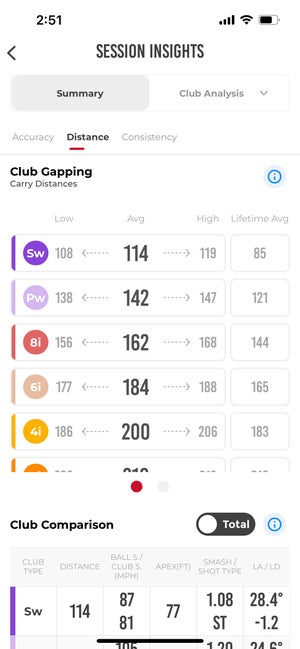
Gapping is, quite simply, the gap between each of your clubs. You don’t want the gap between each of your clubs to be too wide, and you definitely don’t want the gaps to be inconsistent. Any of these could be a sign your clubs aren’t fit to you properly, and it’s easy enough to identify. Just use your launch monitor and hit a few shots with each club in your bag and take the average.
3. Ball Striking Index
This is a new metric that Rapsodo has introduced as part of its update. According to its own website, “you’ll see how often you get within 5% of your maximum ball speed during a specific session and how often you were within 1.5 degrees of your average launch angle.”
This is important not just to illustrate your overall consistency in ball striking, but it will also influence other factors, like your dispersion.