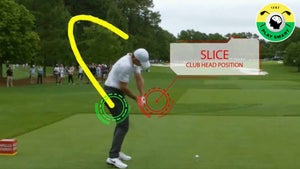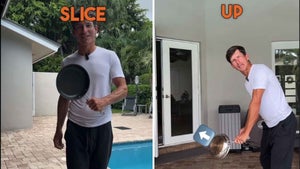
Max Homa plays a lot of golf with recreational golfers — and sees even more recreational golf swings every day on Twitter. There’s one mistake he says he sees golfers make in their swing more than any other.
“The most common problem I see in the golf swing is golfers sucking the clubhead way inside on the backswing,” Homa says. “then they come over the top and hit a big slice.”
Swinging from out-to-in, or “coming over the top” with an open clubface has been the most common problems in golf seemingly since it’s inception, and it’s especially common among golfers who once played baseball. Undoing the tendency to lunge at the ball with your upper body first at the top of your backswing by learning the ideal golf swing sequence is a transition every golfer needs to go through at some point.
But after analyzing millions of golf swings from hundreds of thousands of golfers in the largest golf study ever recorded, GOLFTEC research shows that the problem plaguing your downswing is actually one rooted in the backswing.


GOLF.com Readers Save 15%!
The mistake
Golfers have heard by now that they need to turn on the backswing — and indeed, they do. A big turn creates more power in your golf swing. The problem is what gets lost: You can’t just turn. It’s about how you turn.

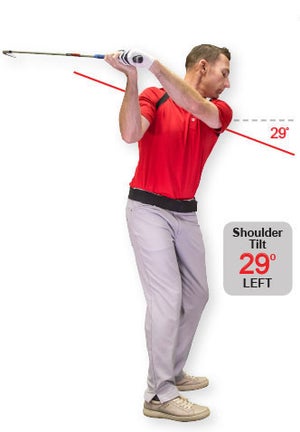
In reality, when you’re turning on the backswing, you also need to tilt. Think of a line that’s drawn across your shoulders, like you see on the golfer to the right: When that shoulder line flattens so it’s more in-line with the ground, it puts your backswing in a position where you’re more likely to come over-the-top. The club is so far behind you and your shoulders are so flat that, as you begin to turn, there’s no other way for your club to move but from out-to-in.
When GOLFTEC studied this, they found a direct inverse correlation between higher handicappers and shoulder tilt at the top of the backswing. In a nutshell: The higher your handicap, the less shoulder tilt you probably have.
Here’s how to get more of it.
The magic move

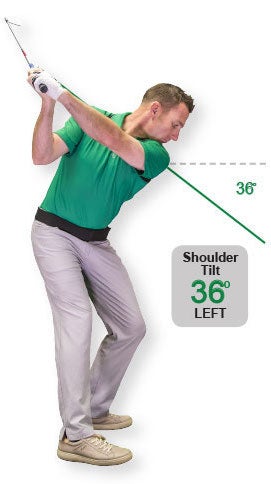
Lower handicaps have more shoulder tilt: About 7 degrees more of it on average, according to GOLFTEC, and usually more. Why is shoulder tilt a good thing? For a bunch of reasons, but among them:
- It puts your hands deeper around you, which helps you stretch more.
- It puts your shoulders in a position where, as they begin to turn in the opposite direction, the club will be delivered back into the golf ball from the inside.
Of course, the beauty of golf is that there’s no one way of swinging a club, and yes, you can overdo it and have too much shoulder tilt. But if you find yourself hitting big pull-slices, you probably need more shoulder tilt, like our man Josh Berhow found out himself on his most recent GOLFTEC journey. Turn and tilt: That’s the formula for low scores and high draws.