Welcome to Shaving Strokes, a GOLF.com series where we share improvements, learnings and takeaways from amateur golfers just like you — including some of the speed bumps and challenges faced along the way.
When it comes to ultimate golf swing-killers, early extension is arguably one of the most popular culprits.
Sure, you can get away with it every so often, but when you can’t quit the bad habit, you’ll struggle to find the consistent contact you want — which only leads to errant shots and higher scores.

Going through a round of golf guessing the direction the ball will travel is no way to play. But there are some ways to cure your early extension issues and start experiencing better ball-striking.
With the help of GOLF Top 100 Teacher Jonathan Yarwood, you can discover a key move that will lead to better contact, giving you better swing sequencing and contact. Take a look below to see what Yarwood has to say.
Stop early extension and start seeing better ball-striking
Ever wonder why your ball-striking is so poor? Most of the time it’s due to the dreaded early-extension and its close cousin; having zero body rotation at impact. Those two really go hand-in-hand.
The earlier you stand up in the downswing, the less chance you have of opening your body. It’s simple, really.
If the spine is straightening and the pelvis is moving forward, there’s a limit in how far you can turn — meaning you’re shortening your rotation. But one commonality that all great ball-strikers have is staying in great golf posture and working around their spine.
To do this, two things must take place in the transition.
First, the pelvis should glide a few inches toward the target (‘reentering’ is the posh name). So the old adage of keeping your back to the target wasn’t too far off — which is why I talk to my players about backing into the shot.
The second thing, which can only happen with a decent transition, is opening your body at impact, which allows the trail knee and ankle to roll in toward the ball after your transition. The video below highlights how to do this singular move.
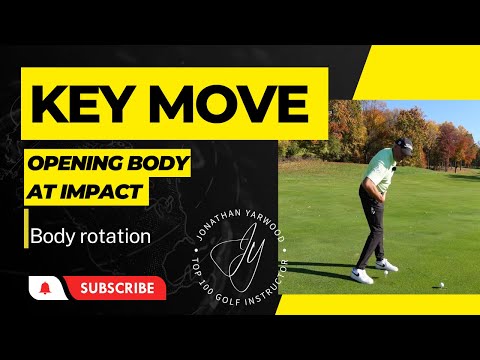
By incorporating this body rotation, it does two things. One, it creates sideband, which helps you stay in posture. Two, while in that posture, it rotates the body to improve your sequencing. Together, these improve your ball-striking ability via more consistent contact.
So start slowly to get the feel for this move, then build it up to regular speed — I promise you’ll love the results once you master it.