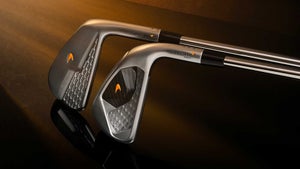
Unless you have the appetite for a driver with an Autoflex shaft or a Tour-only putter, a new set of irons will very likely be the most expensive gear purchase a golfer makes. Depending on how often you play, irons are designed to last between 5-7 years — or more, depending on how often you play — before you need to consider a new set.
We’ve spent plenty of time expounding on the benefits of getting fit for your golf equipment, so instead of banging the club-fitting drum, let’s look at another area of the build process that needs to be considered: loft gaps. Once you’ve found the best iron for your game, a good fitter should go through the bag to ensure gaps between each iron are consistent.
Too big of a gap between your 6- and 7-iron could leave you with plenty of tweener shots. Do you step on a 7-iron or lay off the 6-iron from 150 yards? It’s common to be in-between clubs during a round, but if you can reduce the number of instances where that’s the case, it can make the game more enjoyable.
But how do you figure out the ideal yardage gaps for an entire iron set when most fitters are using a 7-iron to determine the setup? During a recent chat on Ping’s Proving Grounds podcast, Marty Jertson, the equipment manufacturer’s VP of fitting and performance, offered up a simple way to determine the best gaps for your iron set.
“In our data analysis that we’ve done, there’s a good way to figure out your optimal gapping,” Jertson said. “If you go on a launch monitor for a fitting — and we and a lot of our competitors fit with a 7-iron — you take whatever your ball speed is in miles per hour [with a 7-iron] and divide that by 10. That’s a good spacing for your irons.”
So if you typically generate 110 mph ball speed with a 7-iron, your ideal iron yardage gaps would be 10 yards throughout the set, using Jertson’s math. A good way to determine if your yardage gaps are dialed is to get with your fitter (and a launch monitor) after the set is made to figure out standard carry yardages for every club in the bag.
If a gap exists that’s well above or below 10 yards — we’re using 110 mph as the example — between clubs, adjustments can be made to the irons to achieve ideal loft spacing.
The most common tweak is making an iron stronger or weaker to fit the proper gap. Just make sure you don’t go beyond plus or minus 2 degrees when bending the head. Anything beyond that will have a negative effect on turf interaction.
Want to overhaul your bag for 2023? Find a fitting location near you at True Spec Golf.