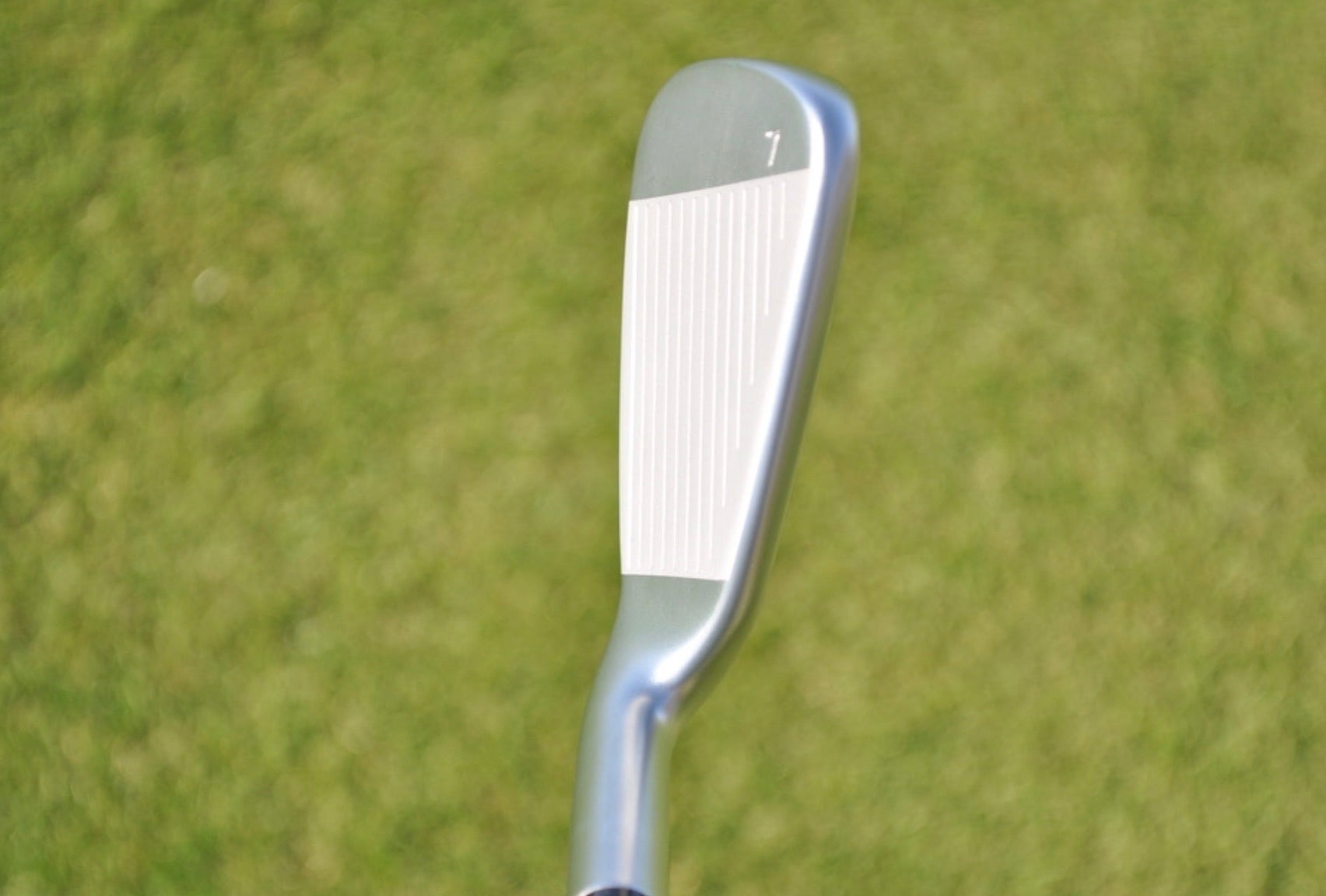
Mention the words “game-improvement iron” to a golfer and a few things usually come to mind: forgiveness, ball speed and a confidence-inspiring profile. In other words, the ultimate club for those who need a little bit of everything.
As we’ve discussed on numerous occasions, the equipment industry is currently going through a “Golden Age of Gear,” where literally every model in the marketplace can help with specific parts of your game. Of course, some products elevate above the pack in critical performance areas.
While combing through the recent data from robotic iron testing with Golf Laboratories’ swing robot, one model made us stop in our tracks. That would be Ping’s G730, one of just three models we tested — out of 25-plus — to produce a carry distance delta that bested the average on heel and toe misses. Only two of those models (Cleveland’s ZipCore XL being the other) produced single-digit deltas.
So why are we pointing this out? Because not every golfer has a common miss, especially if you’re a mid-to-high handicapper. And if you’re unsure if you impact the heel or toe — or maybe both equally — consider adding a piece of impact tape or some foot spray to the face to find out.

But let’s get back to G730’s carry numbers for a second. On toe strikes, distance dropped 9.8 yards, while heel misses only lost 3.3 yards. Combine those numbers and you’re looking at a distance loss of just 6.55 yards on mishits, making G730 the only iron to record a sub-7-yard carry delta when combining heel and toe misses.
Improvements in ball speed retention can be credited to a heat-treated hyper 17-4 stainless steel that made it possible for Ping designers to reduce the face thickness. The result is roughly 2 mph more ball speed, which equates to an extra 5-6 yards through the set.
Add in a tungsten weight in the hosel, toe weights — both move mass towards the perimeter of the head for improved MOI properties — and a PurFlex cavity badge for face flexure, and you have an iron designed to retain ball speeds, regardless of impact location. The G730 also recorded the fifth-fastest ball speed of any iron we tested on the robot, so it has some oomph as well.
It’s not uncommon for a game-improvement iron to possess off-center forgiveness and speed, but based on the numbers G730 put up during our testing combine, it’s a strong candidate for further testing if impact consistency is a problem.
Want to overhaul your bag for 2024? Find a fitting location near you at True Spec Golf.