
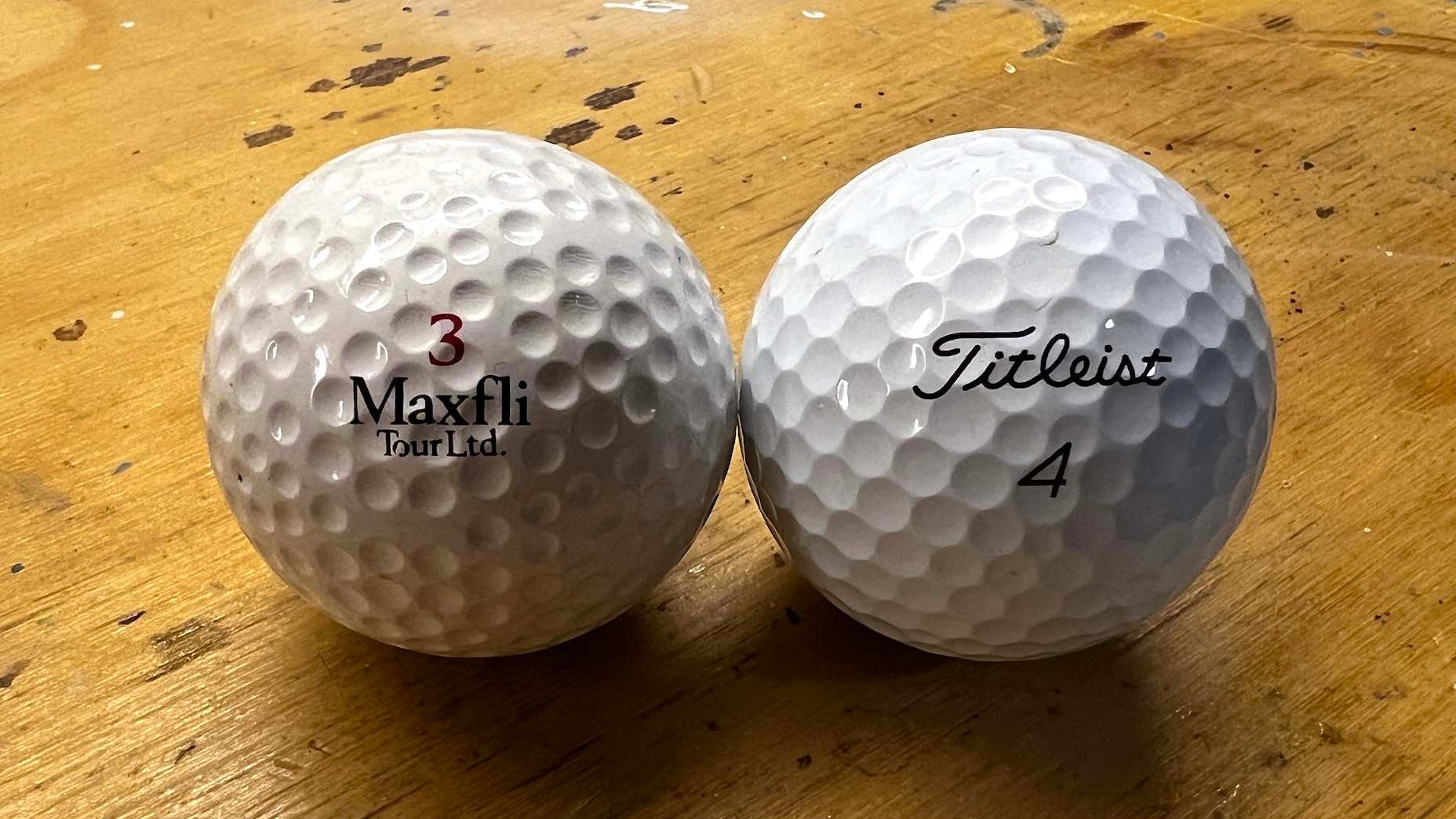
Beyond the fact that Tiger Woods returned to competitive golf this past week, much of the talk in the golf world has revolved around an impending rollback of the golf ball by the governing bodies.
Although opinions are hot on both sides of the topic, and even had Rory McIlroy chiming in, what many fail to realize is this isn’t the first time the rules around the golf ball have changed in the last 35 years. The only difference is most golfers in North American never had to experience it.
Here’s where it all gets very interesting. Before 1952, the Rules of Golf were not uniform around the world, and even as recently as 2003 the USGA and R&A didn’t have the same rules for the spring-like effect of driver faces, aka coefficient of restitution (COR). That’s because in 2003 it was agreed that the legal limit for all drivers would be set to a COR of .830, rather than have it capped at .860 for amateur players and .830 for “highly skilled golfers,” including professionals, which was the initial proposal set forth by the R&A.
Since then, the rules on both sides of the pond and every other corner of the globe have remained the same. With that said, let’s get back to the golf ball and 1952.
After a joint meeting between the USGA and R&A in 1951, which also included the Royal Canadian Golf Association (now Golf Canada) and the Australian Golf Union, it was decided that all of the rules that govern the game would be the same except for one hold out in the UK and Australia — the British ball.
What made the British ball different was its size minimum of 1.62 inches in diameter, compared to the USGA size of 1.68 inches. Although the balls had the same maximum weight restriction of 1.62 ounces, the smaller balls offered a distinct advantage in the wind and when playing overseas, including at the Open Championship. Many professionals also estimated that the smaller British ball offered up to an extra 20 yards of distance off the tee under normal conditions.
As a way of trying to create uniformity, in 1970 the R&A and USGA proposed that the official conforming ball could be no smaller than 1.66 inches in diameter. But after much discussion in the following years, that proposal died in 1973.
Finally, in 1974, the R&A mandated use of the 1.68 inch USGA conforming ball in the Open Championship, again unifying professional golf at the highest level. Still, even though the new rules applied to professionals at the highest level, it wasn’t until Jan. 1, 1990, that the smaller British ball was officially deemed nonconforming under the modern rules, thereby ending the last known example of bifurcation between amateurs and professionals.
This change instantly knocked up to 20 yards off of driver distance at the recreational level in the UK and Australia, and even with that change, participation never wavered, which could be a good indication that any forthcoming new rules will have a limited effect on the public as a whole.
Related Articles


